

Printed Glass vs Stone Splashbacks — Which Is Better?
Choosing between a printed glass splashback and a stone splashback is one of the bigger design decisions when planning a new kitchen. Both can create a premium finish, but they offer very different looks, levels of customisation and design possibilities.
Stone has become extremely popular for its clean, continuous appearance, particularly when matched to a stone benchtop. Printed glass, however, gives homeowners something stone simply can’t — the ability to completely personalise the space with colour, photography, artwork, marble effects or virtually any image you choose.
Printed Glass Splashbacks — Designed Around You
The biggest advantage of printed glass is design freedom. Instead of being limited to the colour and pattern of a particular stone slab, you can choose photography, artwork, abstract designs, marble effects, textures or even your own personal image.
Printed glass also creates a smooth, easy-to-clean surface with very few joins. Because the design is printed behind the glass, the image is protected from everyday kitchen cleaning and wear.
Virtually unlimited design choices
Custom-made to suit your kitchen
Easy-to-clean glass surface
Available in photographic, artwork and marble-style finishes
Creates a genuine feature piece in the kitchen
Stone Splashbacks — Seamless and Sophisticated
Stone splashbacks are popular because they can create a clean, continuous look when matched with the benchtop. Natural and engineered stone can give a kitchen a very high-end appearance, particularly in minimalist designs.
The trade-off is that you are generally limited to the colours, veining and patterns available in the stone itself. Large slabs can also add considerably to the overall kitchen budget.
Premium, seamless appearance
Can match the benchtop perfectly
Durable and easy to maintain
Limited to available stone colours and patterns
Often more expensive for large splashback areas
So Which One Is Better?
There isn’t one answer that suits every kitchen. If you want the splashback to blend seamlessly with your benchtop, stone can be an excellent choice. If you want your splashback to become a feature, add colour, showcase artwork or create something completely unique, printed glass gives you far more creative freedom.
Printed glass can also be a strong option for homeowners who love the look of marble or stone but want greater flexibility in colour, pattern and scale.
See It in Your Own Kitchen Before You Decide
Our free visualiser lets you upload a photo of your kitchen and try different images before making a decision. You can explore scenic photography, artwork, marble-style finishes or your own image and see how it could look as a printed glass splashback.
Try the free splashback visualiser or contact Port Stephens Splashbacks for a free onsite measure and quote.
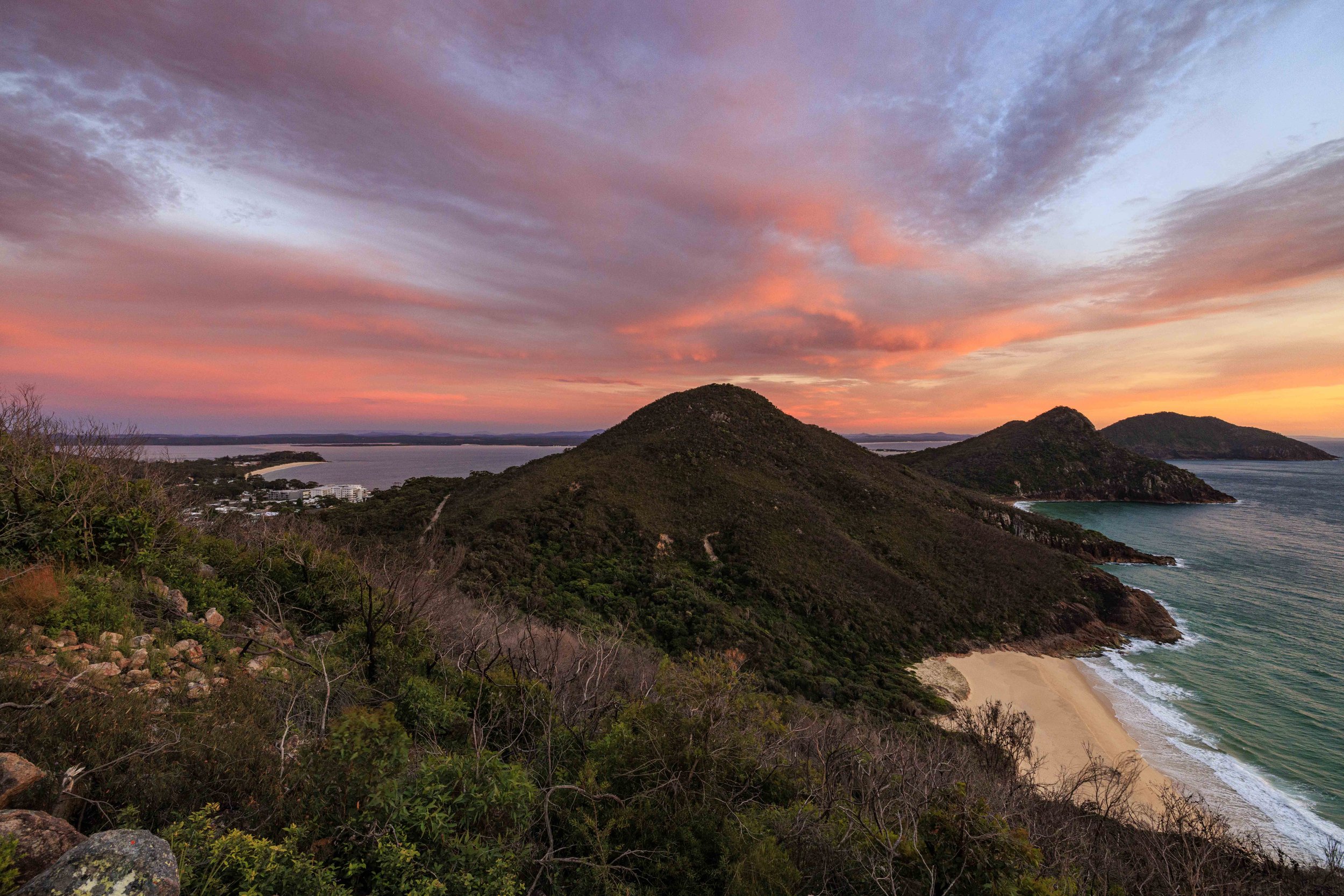
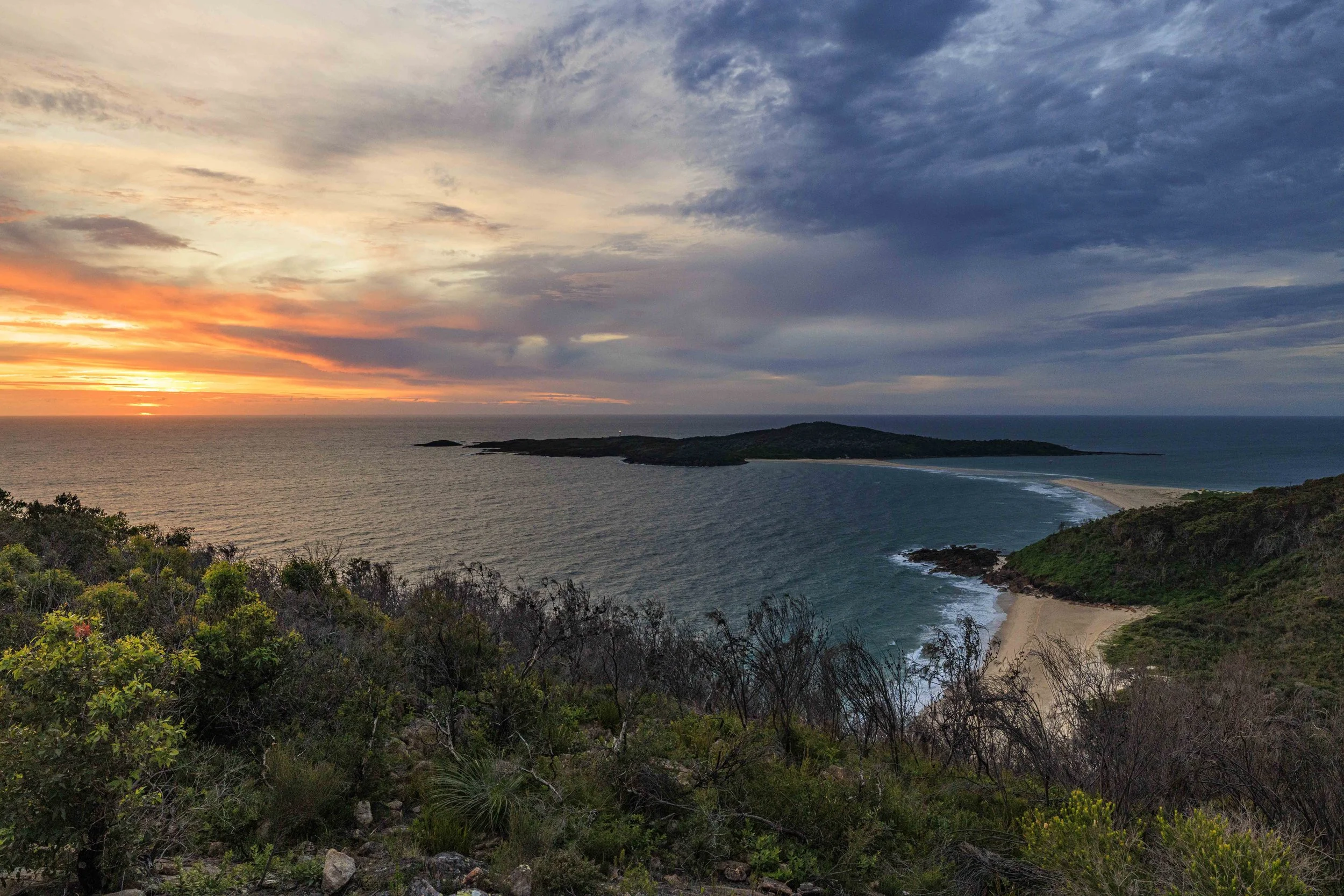
Sunrise from Quarry Hill
This morning the alarm went off at 4:30am, with hopes that the rain would hold off long enough to catch what looked like a promising sunrise. Three hours sleep will have to do today.
Quarry Hill was the destination this time. I wanted an uninterrupted view across to the lighthouse, and knowing its familiar light pattern makes it a little easier to time the shots — 30 seconds, then 6, 6, 6 — as that tiny beam faithfully sweeps across the coast.
Spring is certainly starting to make itself known too. On the climb I came across a sizeable orb spider who had built his web directly across my path. He knew the routine. As I stood there ready to clear a way through, he seemed to accept defeat and quietly made his way up the web to an overhanging branch. A little bit of mutual respect to start the day off.
The cloud forecast was spot on, with a beautiful mix of cirrus and altocumulus stretching across the sky. As first light arrived, the clouds began to glow and before long the whole sky came alive with brilliant colour.
For a few minutes, the lighthouse beam still shone clearly against the morning sky, but as the sun climbed higher its light was eventually overwhelmed by the new day. By then, it had done its job for another night — quietly guiding passing ships safely along the coast.
The rain stayed away, the sunrise delivered, and I came home with a few shots that made the early alarm more than worthwhile.
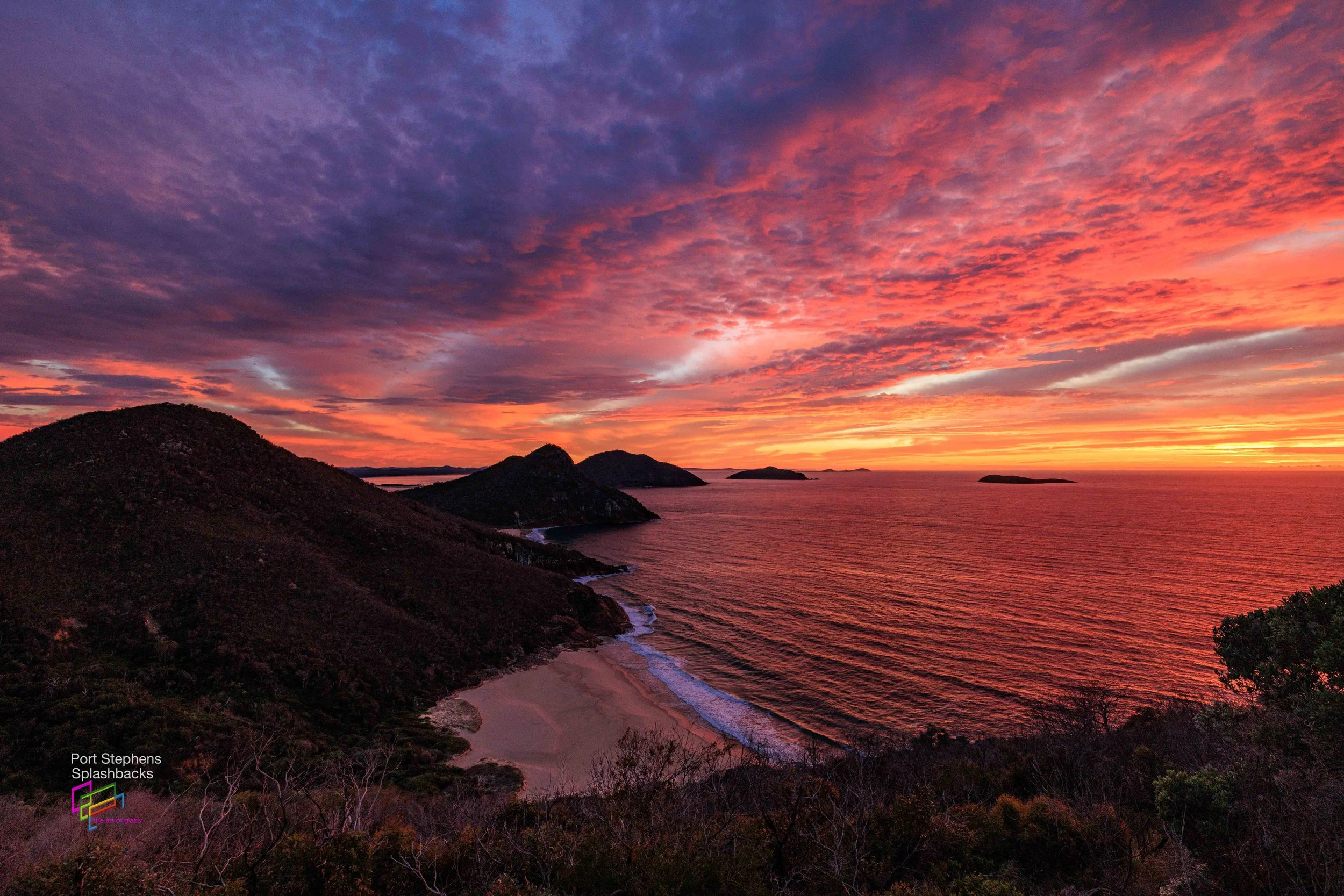
Sunrise from Quarry Hill - Port Stephens NSW Australia
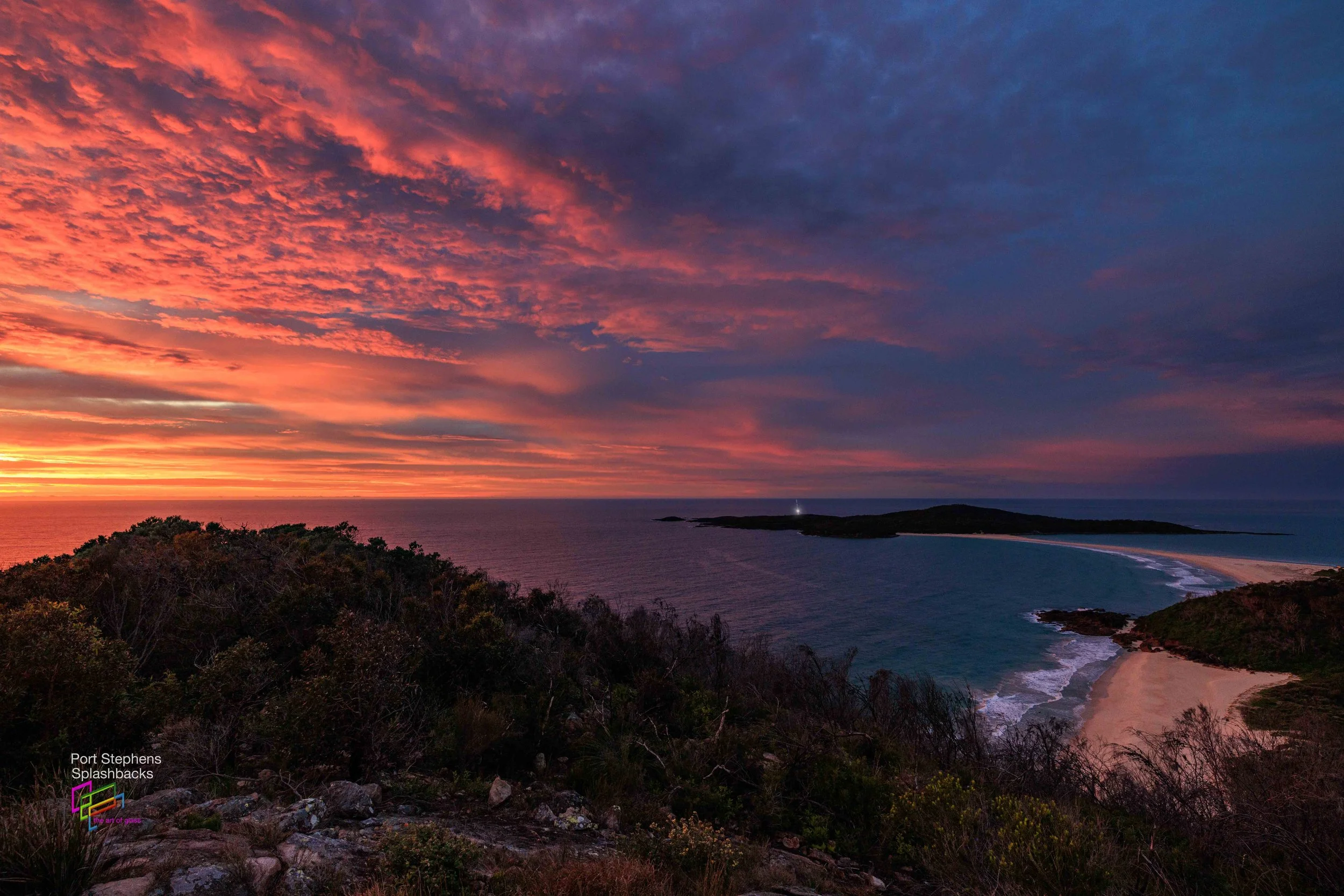
Fingal Island and lighthouse at sunrise 21 August 2026 Port Stephens Australia
How long can we go?
At Port Stephens Splashbacks, we make what we sell. We don’t outsource and we pride ourselves on continually developing the product to give the superior quality people expect from a Hunter-based business. You can be assured that the person you deal with is the same person who will be getting their hands dirty on the factory floor. We don’t project manage or outsource the work- so we maintain consistently high standards without dealing with overseas companies who farm the work out to various sub-contractors. When we say “printed glass splashbacks - that’s what you get. We don’t print onto vinyl stickers and slap them on the back of the glass. We print directly to the glass… and that’s the big difference. That’s why we can offer a 10 year guarantee against peeling, cracking, fading and delaminating- because we know how to print to glass.
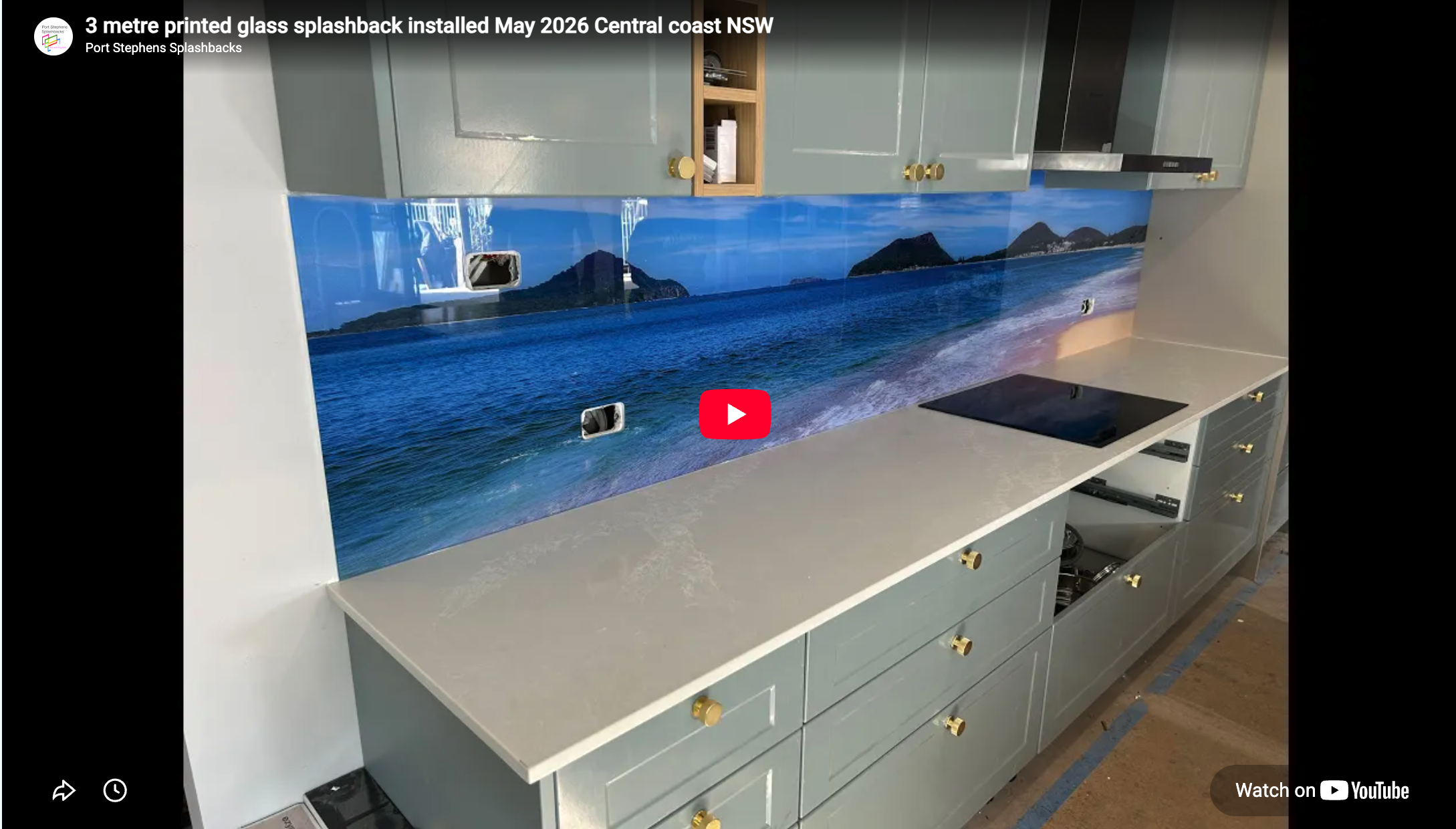
Our printer handles glass sizes up to 3.2 m x 2m. To print larger sizes requires the glass be printed in two pieces - however you can be assured that the print is going to maintain its quality for life and won’t deteriorate over time. Quality is always our number one priority.
Check out this 3.2m splashback we installed in May 2026 in Wyee NSW. The powerpoints are ready to be installed and don’t you just love the effect of the waves crashing onto the benchtop? That was a pure coincidence because of the colour of the marble pattern of the benchtop - but it really does make it look and feel like a window.
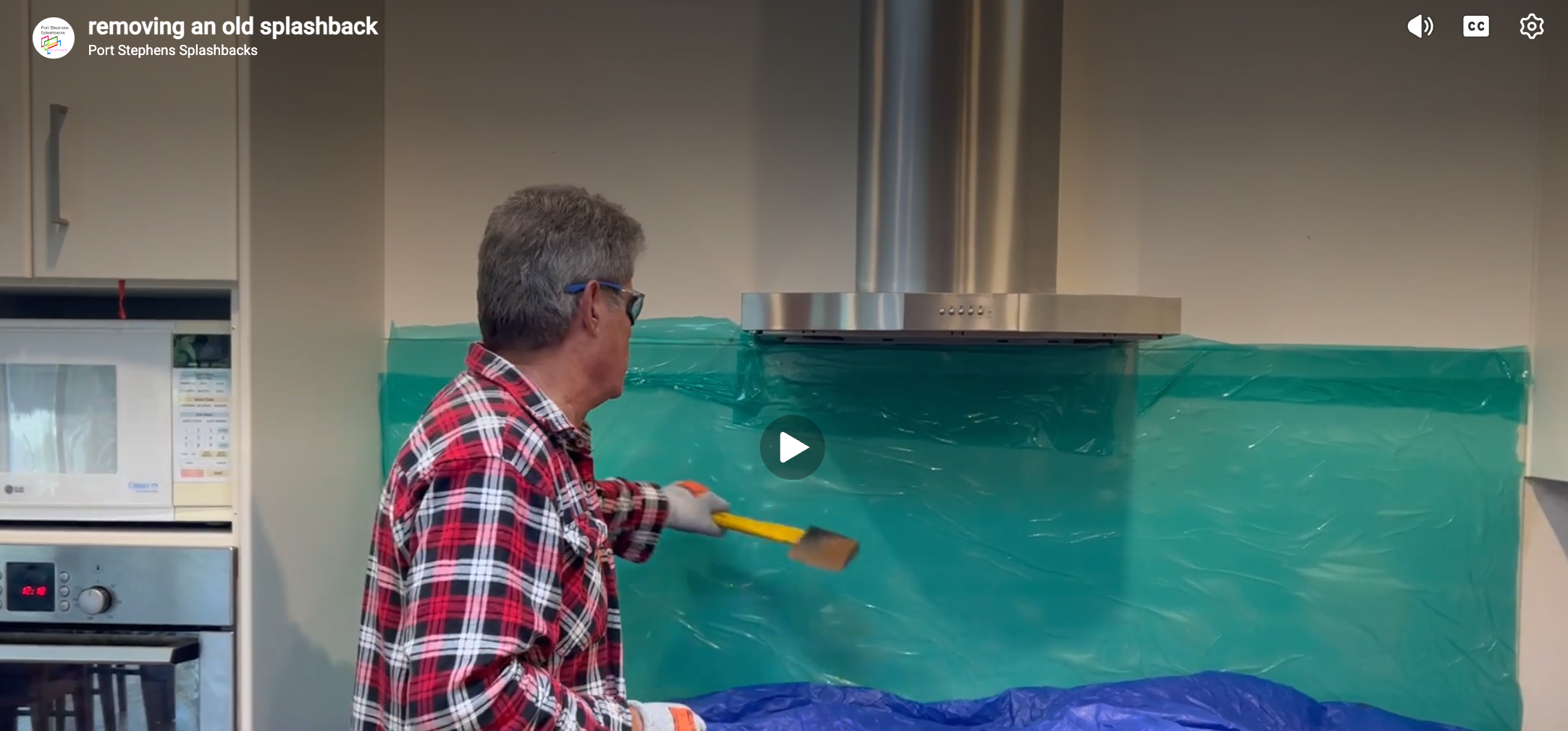
removing an old splashback
If too much silicone has been applied to a splashback, it is virtually impossible to remove using the usual leverage techniques. If that happens the only alternative is to smash it- however toughened glass is designed to be impact resistant. In that case you need to find a weak point such as a GPO cutout. If there’s no weakpoint, then you need to create one. Here’s a simple hack to break toughened glass so that it can be safely removed using a paint scraper.
We place a sheet of industrial protective film over the glass to prevent the beads of glass from flying everywhere.
The using a hammer drill, we drill a hole in the glass to create the wek point. then a simple tap - and the glass is ready to be safely scraped off.
Happy Birthday Mum
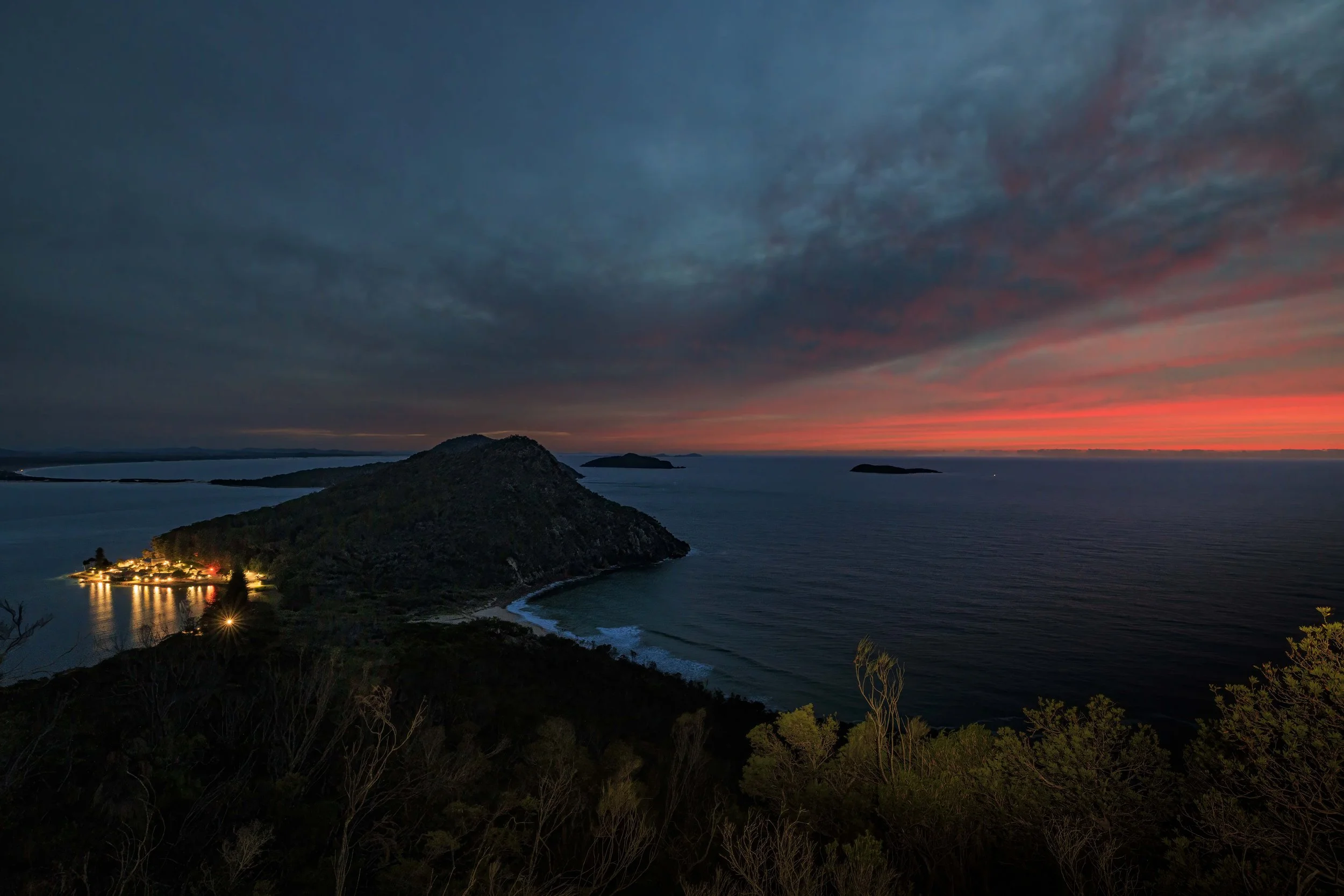
The view from Stephens Peak 17/03/2026
Today, while many people celebrate St. Patrick’s Day, my heart always turns somewhere deeper — to my mum and the life she lived. Today is her birthday.
Mum used to say, “It’s the thought that counts.”
As a kid I thought that was just her way of making modest gifts feel special. But as the years passed, I realised it was one of the greatest life lessons she ever gave me. What truly matters isn’t the size of the gesture — it’s the love, effort, and intention behind it.
Her life wasn’t easy. She endured the unimaginable loss of her first daughter at just 18 months old. Yet she carried on, raising four kids with strength and determination. Years later, her heart was shattered again when my younger sister Carolyn passed away just before her 30th birthday. I’ve never known anyone who carried such grief with the grace, resilience, and quiet courage that Mum did.
There was a time when things were incredibly tough and Mum was homeless - with four kids in tow. But even then, Mum never let despair define us. She lifted our spirits and took my brother and I to sing at a church concert in San Souci that we had been rehearsing for months. That performance ended up changing our lives — someone in government saw it and helped our family find a home. We went on to join a choir and were always on the road. Shopping Centres, television, recording studios, the Sydney Opera House, rehearsals every week. Mum had ironed our uniforms, driven us there, and sat proudly in the audience like she always did. She was our biggest supporter as we travelled and performed on stages around the country.
Her love carried into every chapter of my life — even the difficult ones. During my struggles with alcohol, it hurt her deeply, but she never stopped believing in me. Because of that love and support, I found recovery more than 15 years ago. Today I live a healthy life, chasing sunrises and staying active — something she always loved. Oddly enough, I am much healthier now at 64 years old than I was in my thirties - it's a gift that I proudly keep in memory of Mum. Now that she has passed it became acutely aware that she is constantly watching me- so these days I cannot get away with anything as I might have tried to when she was alive.
This morning I thought about the frangipani tree she gave me many years ago. It has grown strong and beautiful, just like the love she planted in my life. I picked some flowers and placed them at her plaque on the eastern side of Stephens Peak — a place with a view I think she’d appreciate.
Mum, your words, your strength, and your love still guide me every single day.
I'm sure Mum would have been amused at me carrying a posy of flowers through the bush, in the dark, with a ton of camera gear on my back, fighting through the spider webs on the climb to the top of Stephens Peak. I am astounded that I managed to get said posy to the top in one piece - Mum knew how much of a klutz I am.
I was hoping that I might get a vivid sunrise this morning- and for a brief while there was some colour- but it turned to grey – but as you say… It’s the thought that counts.
Happy Birthday Mum. ❤️
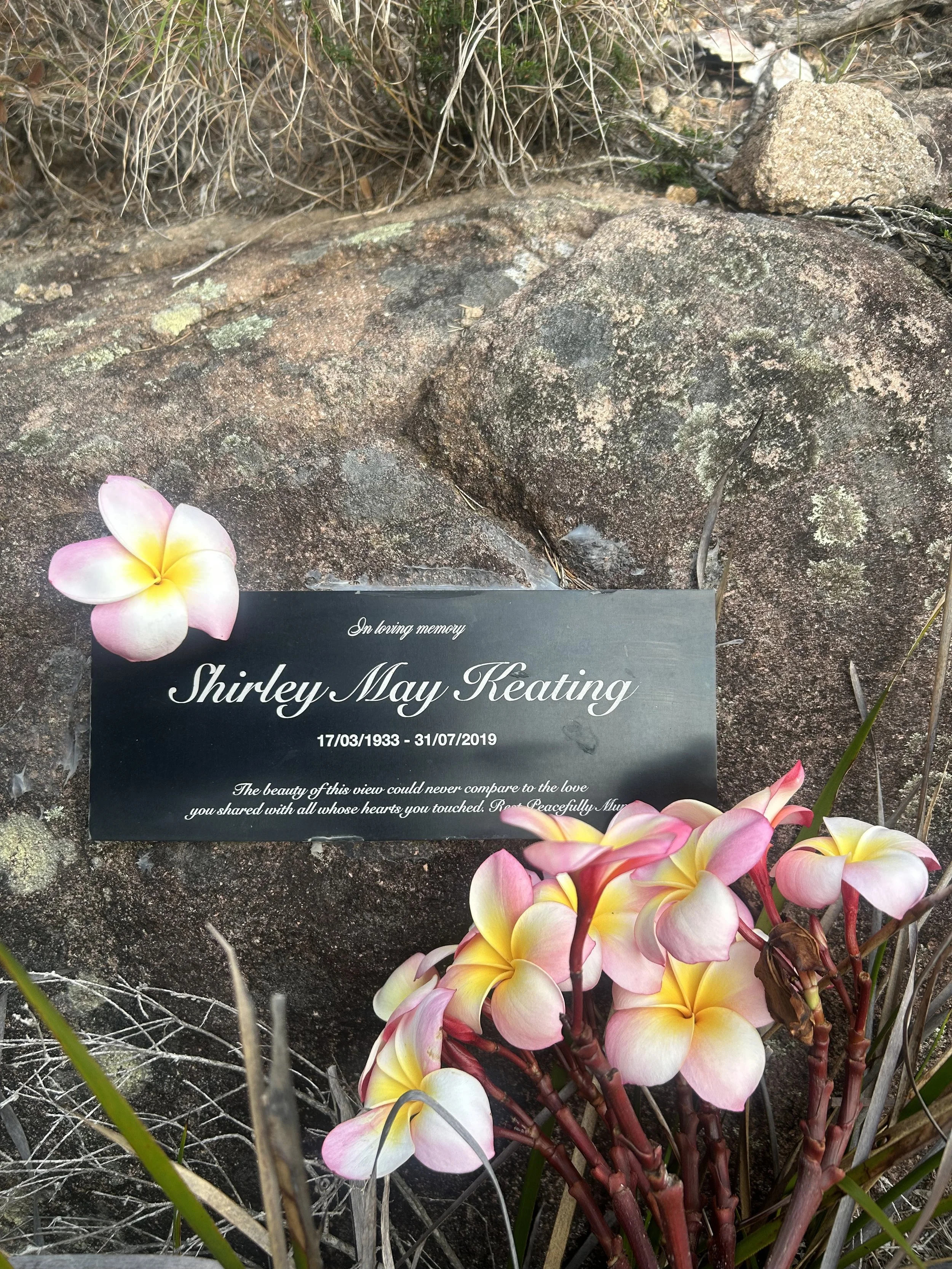
Mum’s favourite frangipani from my garden
Eyes to the skies this week!

lunar eclipse time lapse over Shoal Bay September 2026
The night sky is about to put on a much more sleep-friendly show.
On 3 March 2026, a lunar eclipse will grace the evening hours — a welcome change from last year’s event that had many of us rubbing our eyes and clutching thermoses of coffee in the early hours of the morning. This time, the timing couldn’t be kinder: the eclipse will unfold as the Moon is rising, making it far easier to catch without sacrificing a full night’s rest.
A perfectly timed celestial event
The eclipse will begin at 10:04 PM, just as the Moon climbs into view. From there, Earth’s shadow will steadily creep across the lunar surface until the moment of maximum eclipse between 10:33 PM and 10:33 PM, when the Moon will appear at its darkest and most dramatic. The event will then gradually wind down, concluding at 11:02 PM.
Because the eclipse happens during moonrise, there’s something extra special about this one. Watching the shadowed Moon emerge above the horizon can create a striking visual effect — the Moon often appears larger and tinted with warm hues due to atmospheric scattering near the horizon.
Fingers crossed for clear skies
As always with skywatching, one factor remains out of our control: the weather. Lunar eclipses require nothing more than clear skies and a good view of the Moon, so let’s hope cloud cover stays minimal on the night. Even thin cloud can soften the view, while a clear sky reveals the subtle reds and copper tones that make eclipses so memorable.
A gentler experience than last year
Many skywatchers will remember last year’s eclipse, which ran roughly between 1 AM and 5 AM — a much tougher commitment for those balancing work, family, or just a love of sleep. Still, those who made the effort were rewarded with spectacular views, especially from elevated vantage points. A photograph taken from the summit of Stephens Peak captured the Moon glowing softly in Earth’s shadow, a reminder of the magic that comes with staying up late for the sky.
This year, thankfully, no all-nighter is required.
Don’t miss it — the wait will be long
If you’re thinking, “I’ll catch the next one,” you might want to reconsider. After this event, the next full lunar eclipse won’t occur until 2028. That makes the March 2026 eclipse a rare opportunity — not just astronomically, but also in terms of its unusually convenient timing.
So mark your calendar, set a reminder, and maybe scout out a good viewing spot ahead of time. With a bit of luck and clear skies, the rising eclipsed Moon could provide one of the most beautiful nighttime sights of the year — no alarm clock required.
Direct hit!
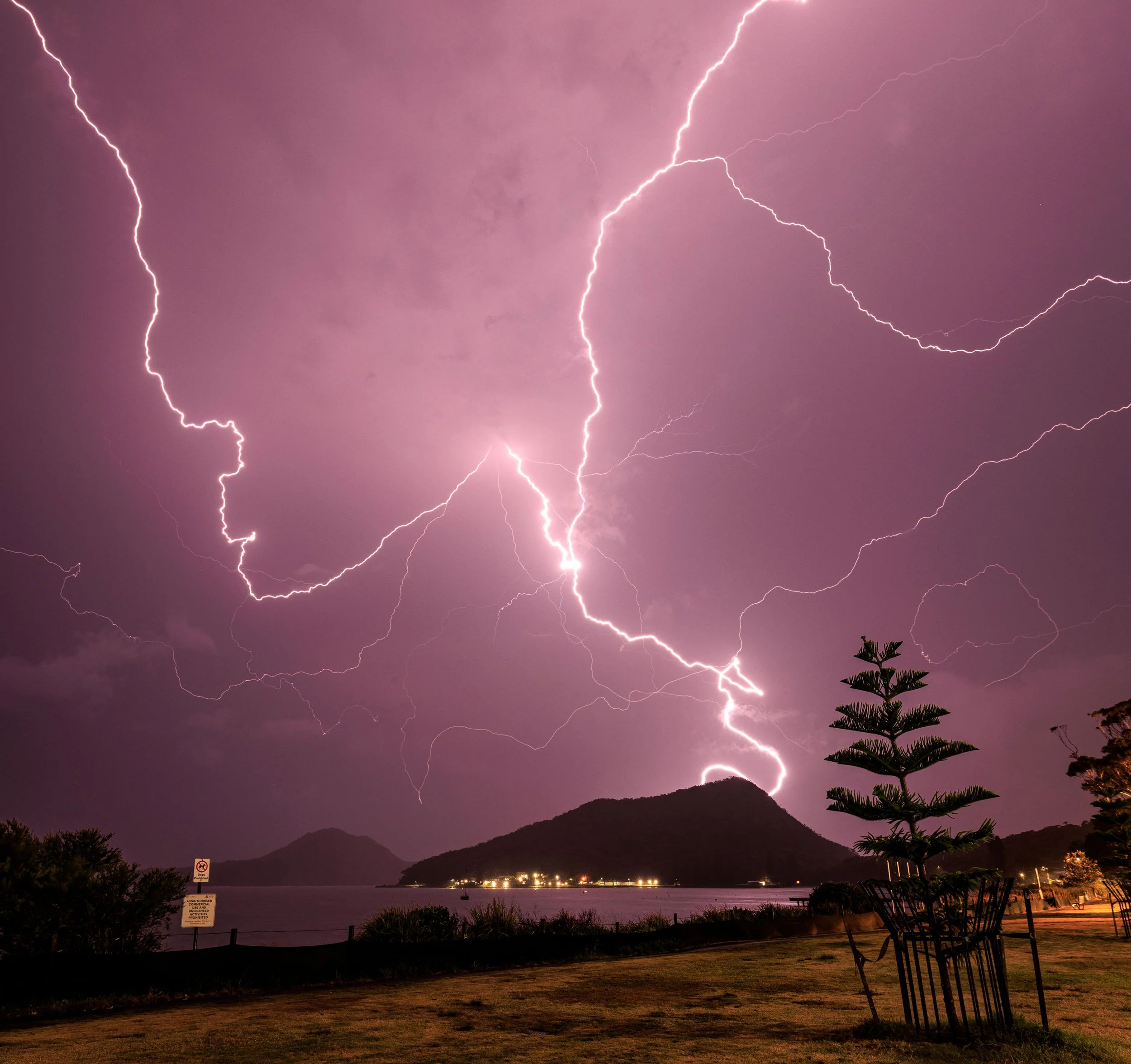
Tomaree cops a direct hit from a crawler lightning bolt that exploded over Shoal Bay
Chasing the Uncatchable
For more than two years I’ve been returning to the same spot, tripod planted, camera pointed stubbornly toward Tomaree Mountain. Night after night, storm after storm, I’ve tried to capture lightning striking exactly where I want it in the frame. And night after night, I’ve gone home empty-handed.
The composition has never changed. Tomaree is the anchor — solid, familiar, immovable. The problem is convincing something as chaotic as lightning to cooperate. Getting a bolt to hit Tomaree feels like an exercise in patience, futility, and mild self-inflicted madness. Add heavy rain into the mix — soaked clothes, a wet lens, blurred frames — and the odds have never been in my favour.
Still, I kept coming back.
On 01 February 2026, a storm began rolling in from the west. At first glance it didn’t look particularly promising. There wasn’t much rain, which was a good sign, but there also wasn’t much lightning. It felt like it might be yet another long night of waiting, listening, hoping — and packing up with nothing to show for it.
Chasing lightning is a lot like watching a scary movie. You know the jump scare is coming. You’re completely aware that this exact moment is the reason you’re there. And yet, when it finally happens, it still makes you jump out of your skin.
This storm was creeping in from behind me, which meant I couldn’t see what was coming. I could hear it though — deep, rolling thunder, plenty of energy moving in my direction. The plan was simple: let it pass over the top of me and hope something happened in front of the lens.
Then it did.
A massive crawler bolt ripped across the sky and exploded just in front of me. The light was blinding — the kind that momentarily erases everything else. Instinctively, I flinched. For a split second I didn’t even know if the camera had caught anything at all.
When I checked the screen, there it was.
The bolt had burst across the sky and streaked downward toward the peak of Tomaree, striking what looks to be the metal viewing platform on the eastern side of the mountain. After years of trying, years of wet lenses and missed opportunities, I finally had the shot I’d been chasing.
The best part? I didn’t even get that wet capturing it.
Sometimes persistence doesn’t pay off quietly. Sometimes it arrives all at once, in a flash of white light and rolling thunder — and reminds you exactly why you keep coming back.
Welcome to 2026

NYE at Nelson Bay 31/12/2025 9PM fireworks from onboard the Hinchinbrook Explorer
Starting Fresh for 2026
As we step into 2026, it feels like the perfect moment for fresh beginnings and exciting plans ahead. After a well-earned break, we’re recharged, inspired, and ready to get back to doing what we love—helping transform kitchens and bathrooms into beautiful, functional spaces.
It’s been a lovely holiday period, with truly wonderful weather here in the bay. The slower pace, sunshine, and time to reset have reminded us just how important it is to start the year with clarity and enthusiasm—and that’s exactly the energy we’re bringing into the months ahead.
While our factory officially reopens on 19 January, we’re already getting started. From this week, we’re offering free measures and quotes for anyone who’s ready to plan their kitchen or bathroom transformation. Whether you’ve been dreaming over designs during the break or you’re simply keen to get ahead before the year fills up, now is the perfect time to begin.
Planning early means you can explore ideas, refine details, and lock in your project with confidence—without the rush. Our team is looking forward to meeting you, understanding your vision, and helping turn those ideas into a space you’ll love for years to come.
Here’s to a fresh start, new projects, and an exciting 2026 ahead. We can’t wait to welcome you back and get started.
Chasing the Supermoon
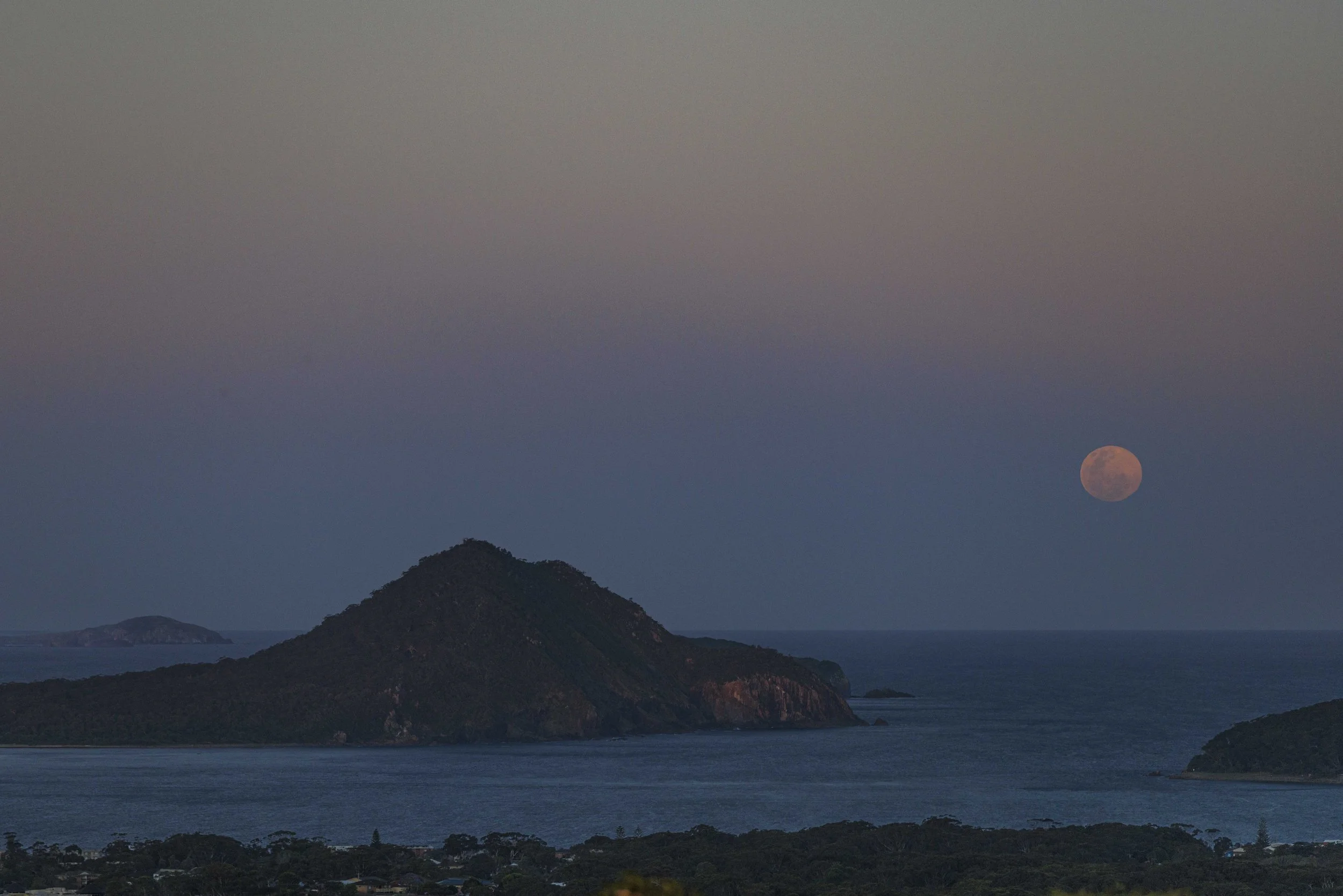
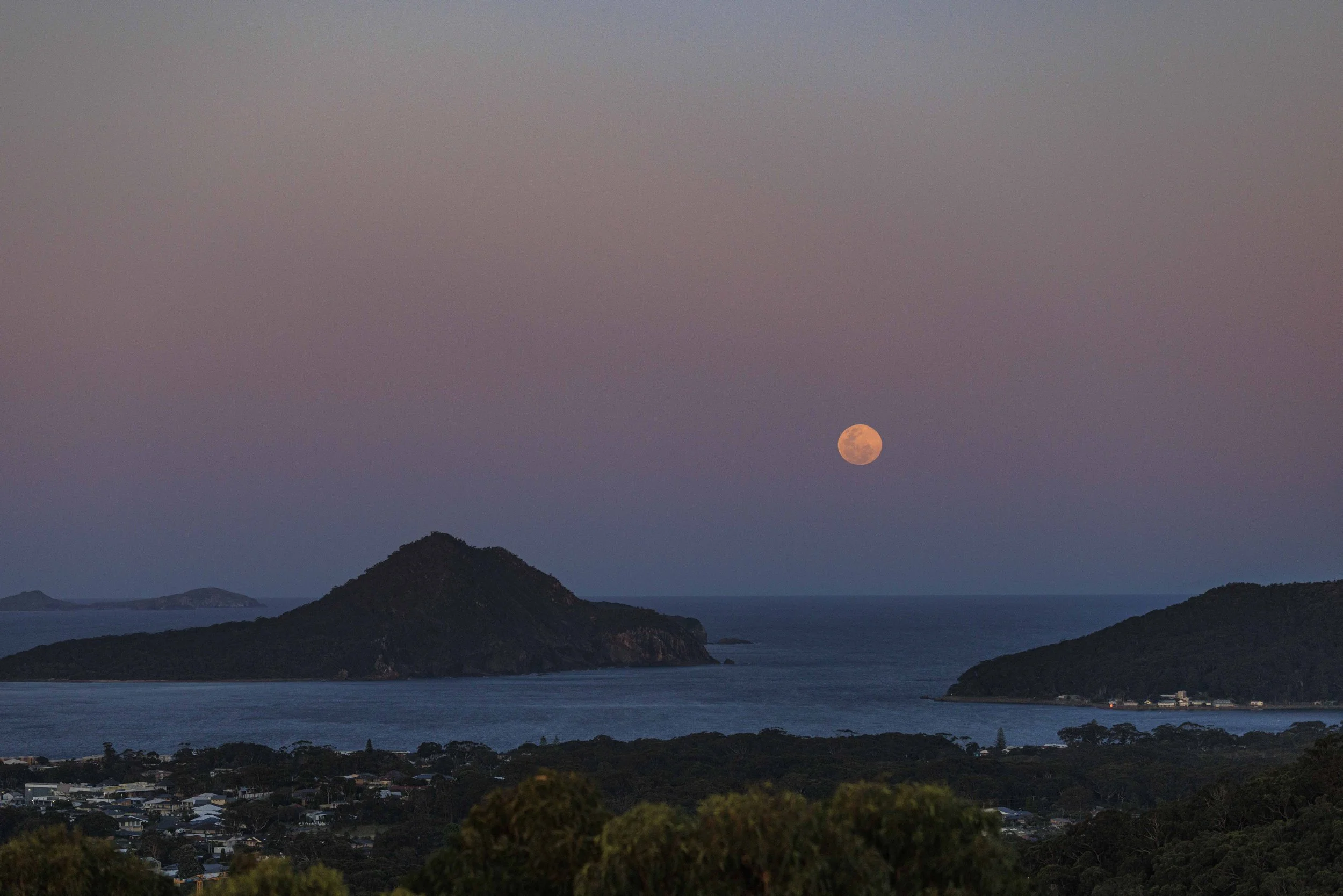
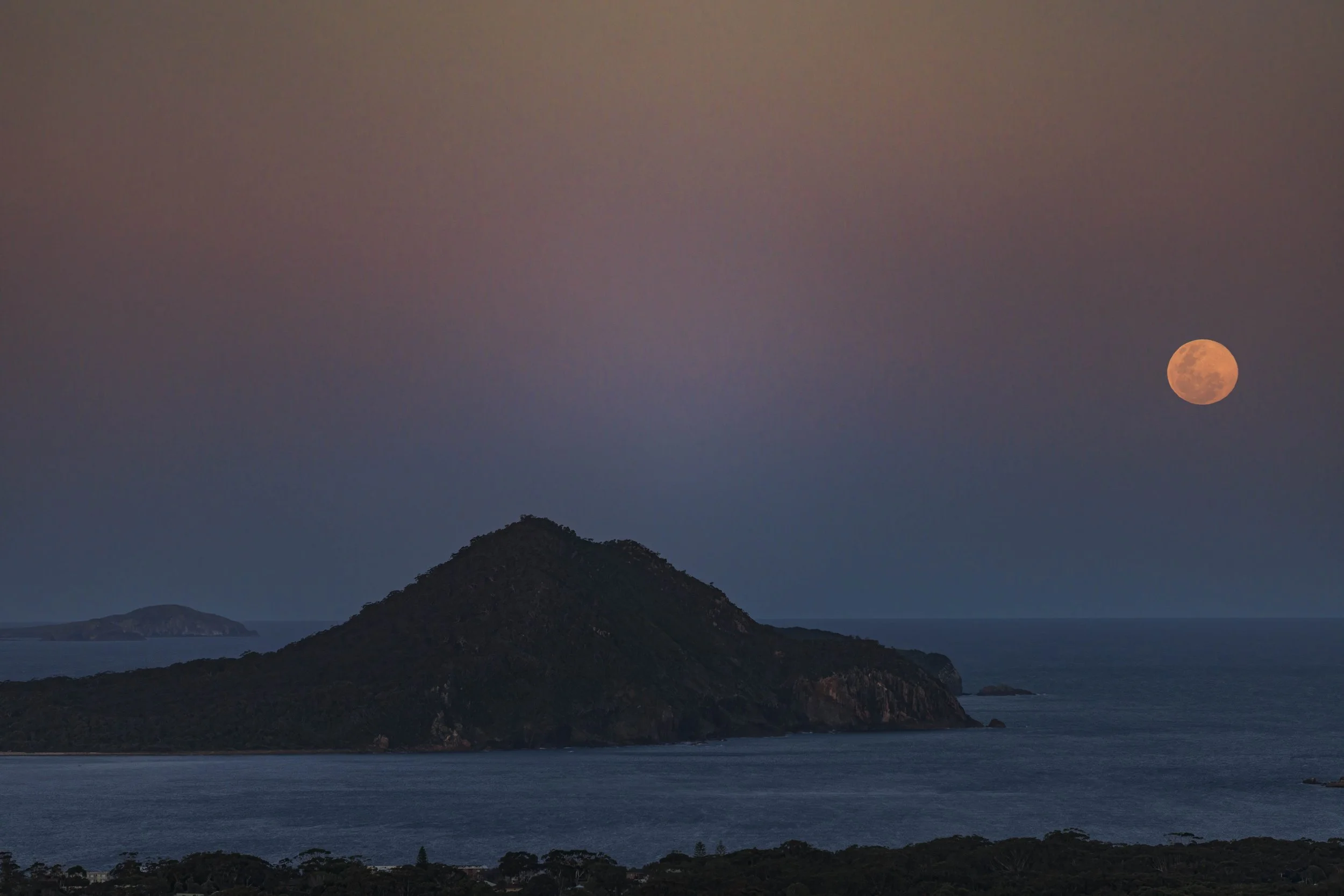
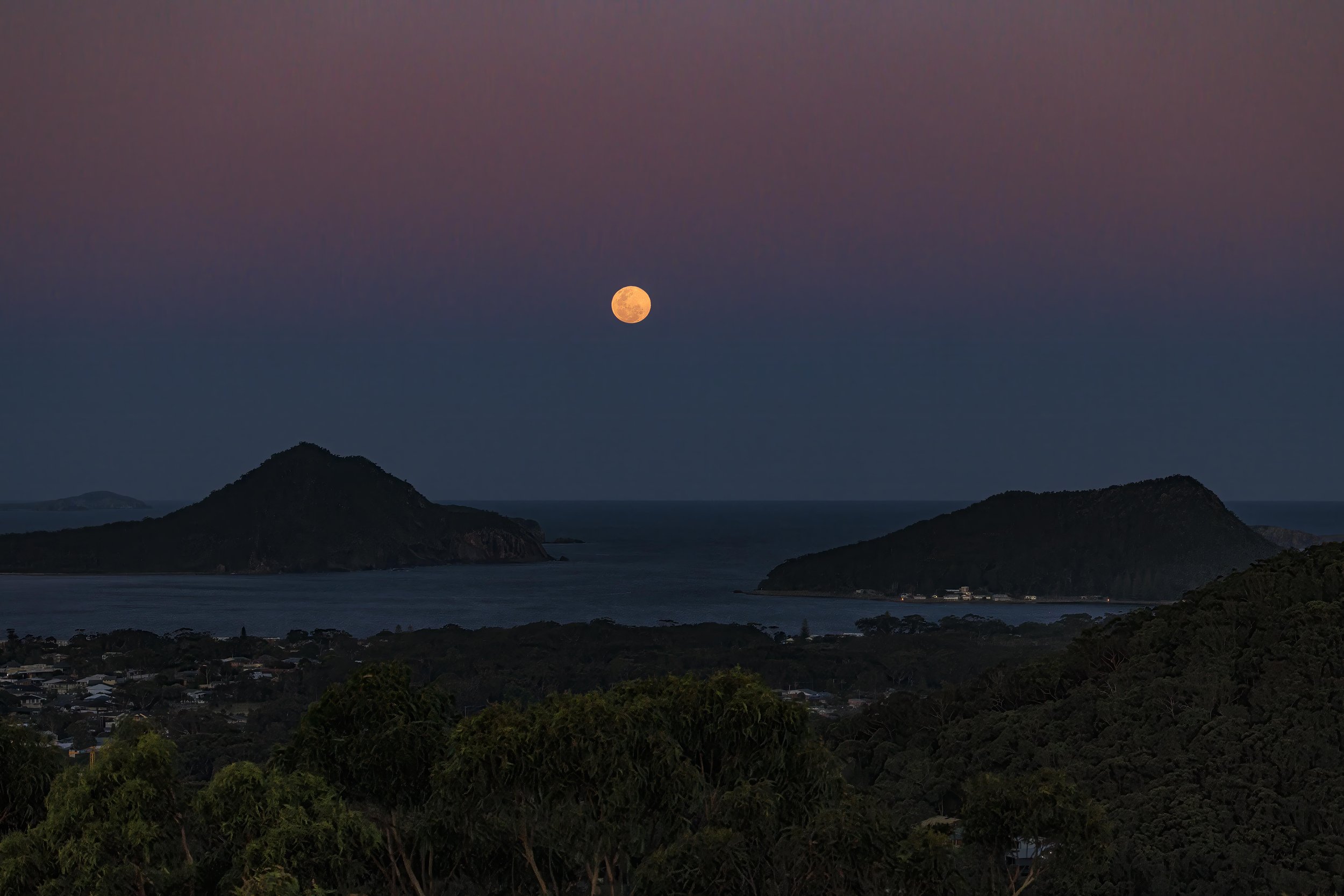
From Lilly Hill, I watched the horizon breathe light — a red moon rising through smoke and silence.
There’s a certain pull to a moonrise — that slow, silent ascent that feels less like watching the sky and more like witnessing time itself unfold. When I saw the forecast for a supermoon over the Tomaree Headlands, I knew exactly where I wanted to be: Lilly Hill. It’s not the tallest peak, but it offers a clear line to the east, a perfect window to the horizon where the moon would lift itself from the sea.
By late afternoon, the air was thick with the faint tang of smoke. Somewhere beyond the bay, burn-offs had left a hazy veil hanging over the coast. The sky itself was restless — scattered clouds drifting westward, catching the warm tones of the setting sun. It was one of those evenings when the world feels suspended between two kinds of light.
I set up on the lookout, the bush below whispering in long, slow breaths. Nelson Bay township was beginning to settle in for the night- the lights had not yet turned on. The moon was due to rise just minutes before sunset — a rare overlap when the day and night share the same sky. As the sun sank behind me, the western clouds turned molten, washed in pinks and copper-reds that deepened by the minute. The smoke haze turned the horizon into a soft watercolor blur.
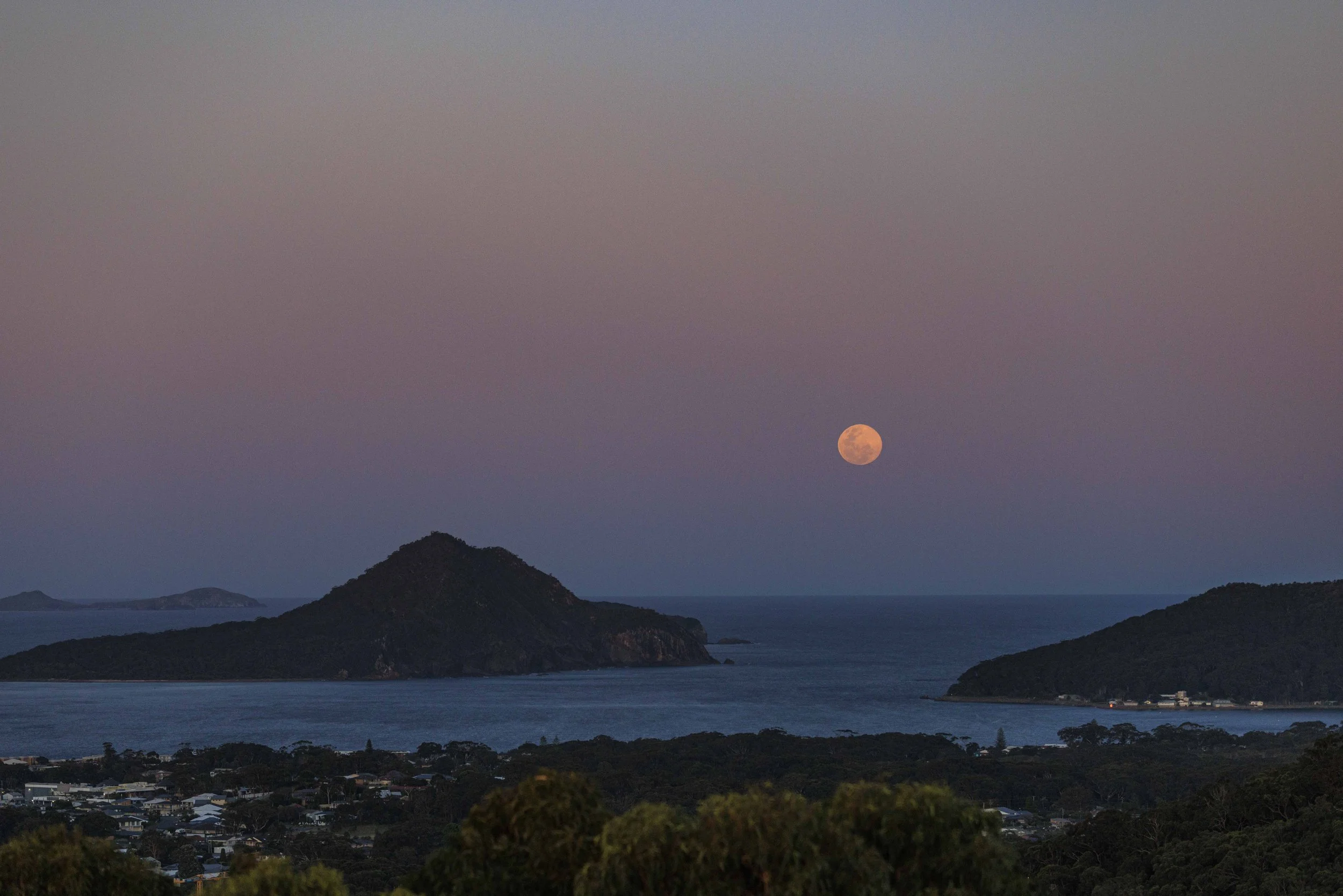
The sleepy town of Nelson Bay settles in for the night as the supermoon rises in the background through Tomaree Headlands.
Then, almost imperceptibly at first, the moon appeared. A dull orange disc, rising through the haze like an ember lifting from a dying fire. It swelled as it climbed — vast, luminous, impossibly still — threading itself through the folds of Tomaree’s dark silhouette.
For a while, everything was quiet. The birds had settled. The wind had eased- but thankfully kept the mossies at bay, those things are relentless up here. The light had equal weight on both sides of the sky — sun fading west, moon blooming east. The smoke gave it a strange beauty, muting the glare and painting the moon in tones of rose and rust.
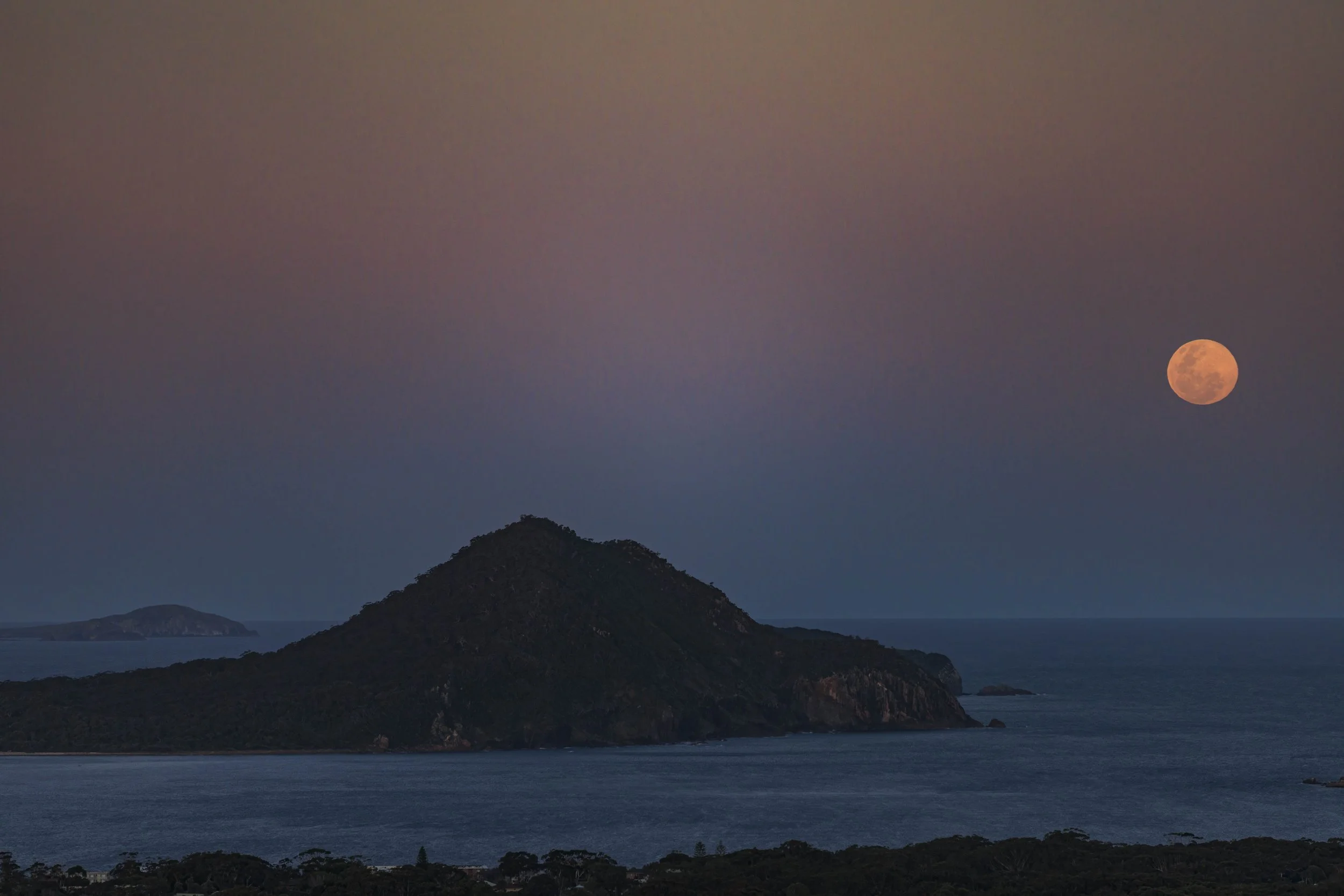
Yacaaba with the moon rising to the south of it.
Standing there on Lilly Hill, watching the balance shift from day to night, I thought about how often we chase light — sunrises, sunsets, moonrises — as if they’re fleeting things to be captured. But moments like this remind me: they’re not trophies. They’re invitations. To pause. To notice. To remember that even through haze and imperfection, beauty finds its way through.
Author’s Note
The supermoon that night didn’t blaze gold or silver — it rose quiet and red, veiled by smoke and dusk. But maybe that’s the point. Sometimes the beauty isn’t in clarity, but in the soft blur that makes you linger a little longer before the light fades.
Between Darkness and Dawn
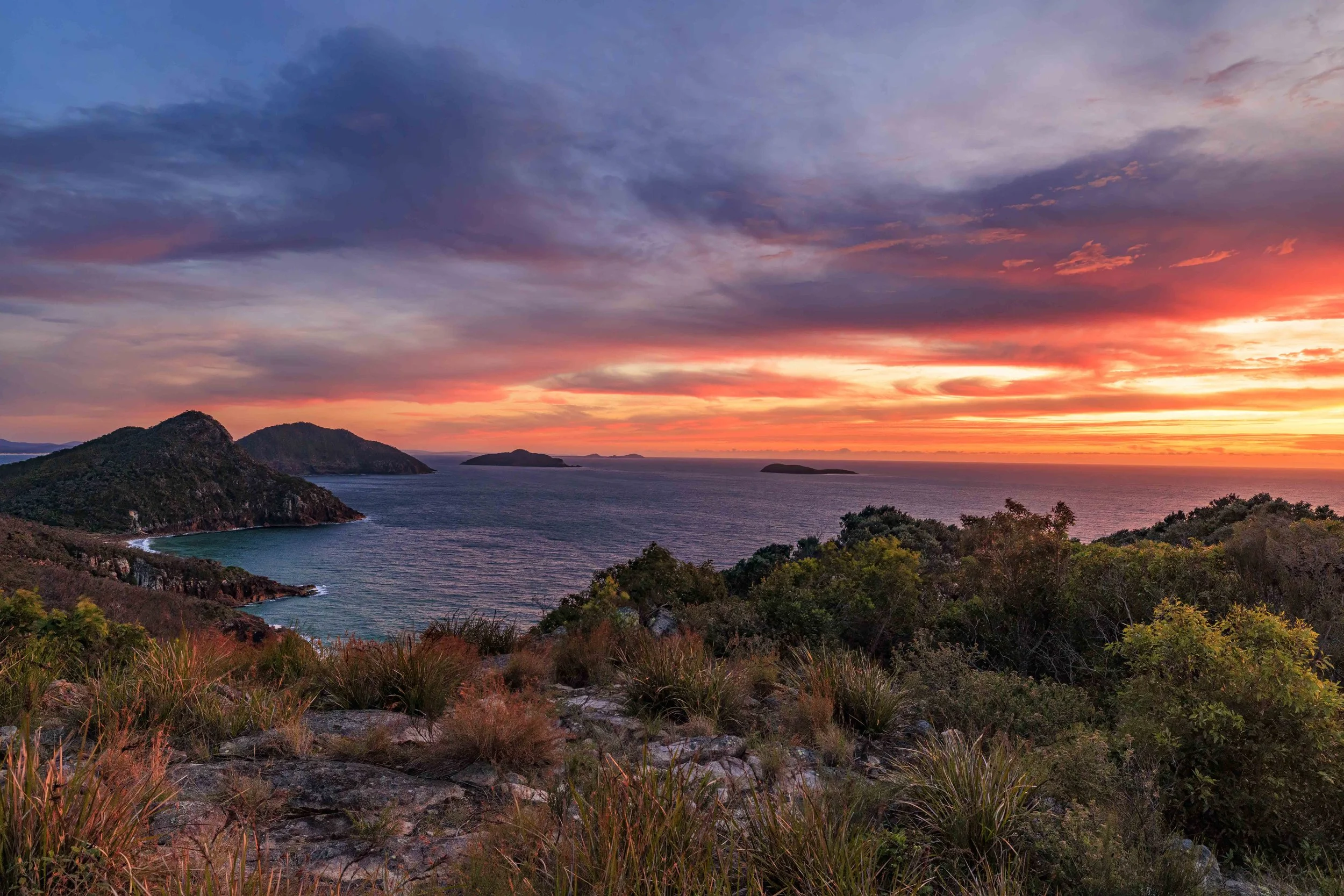
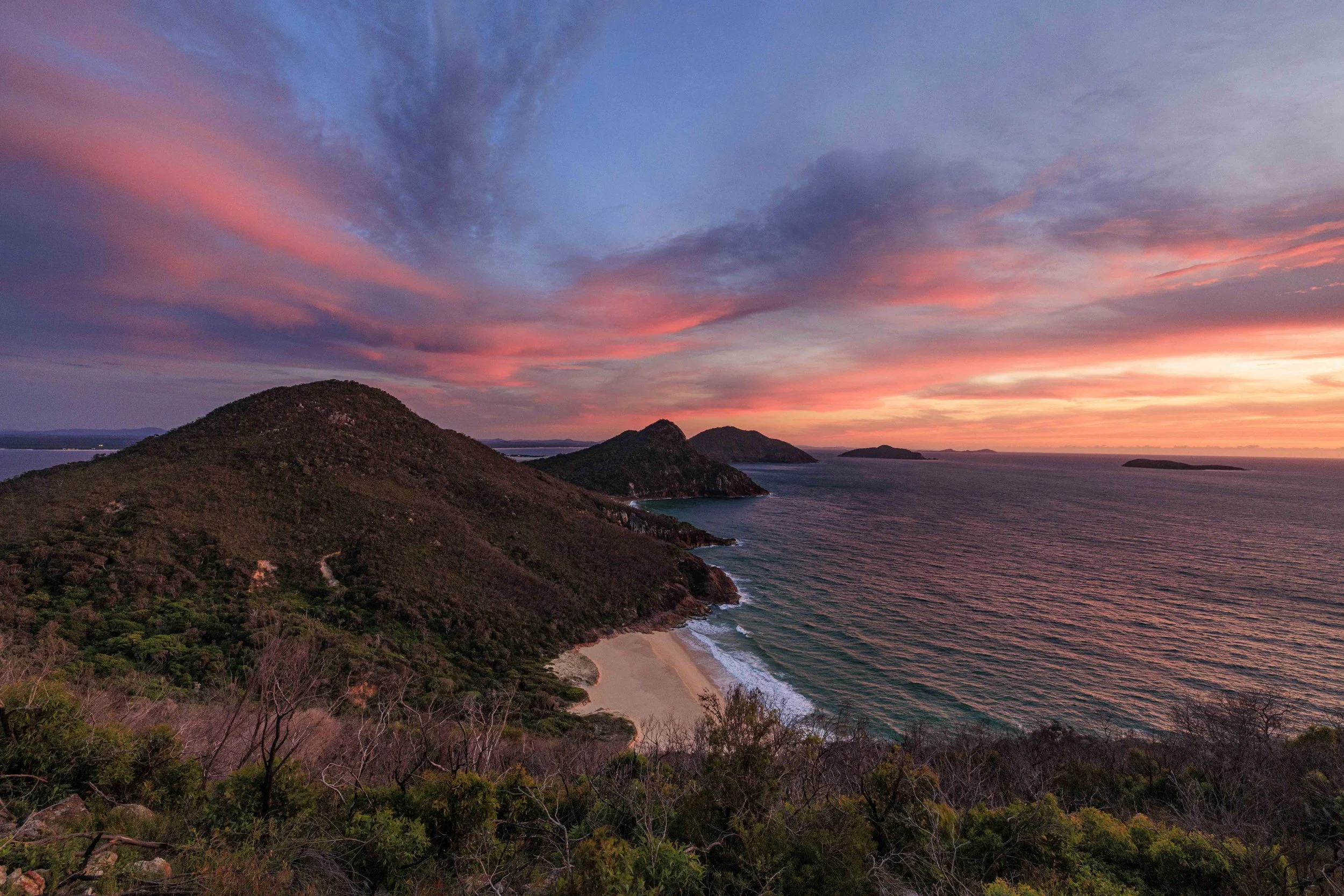
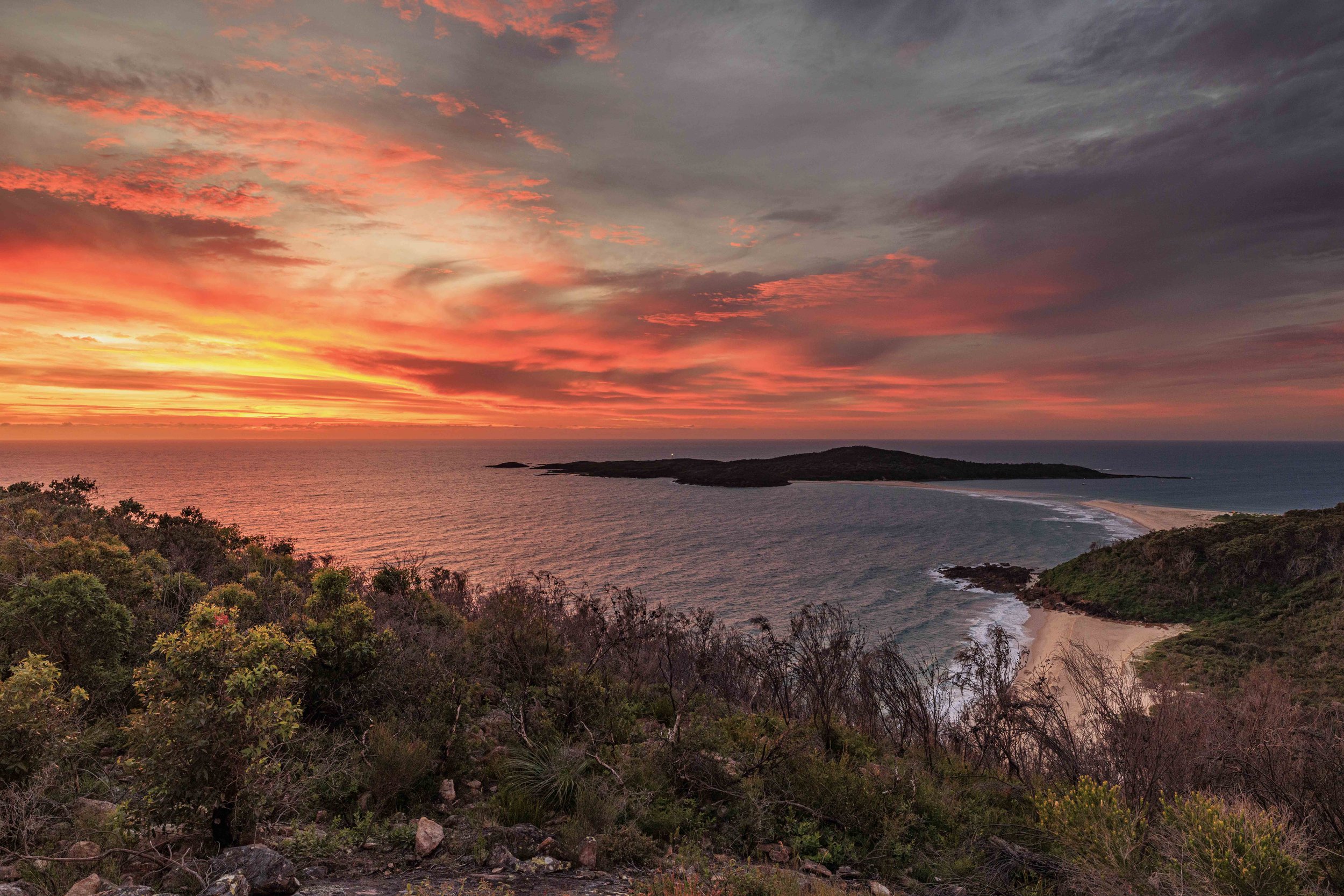
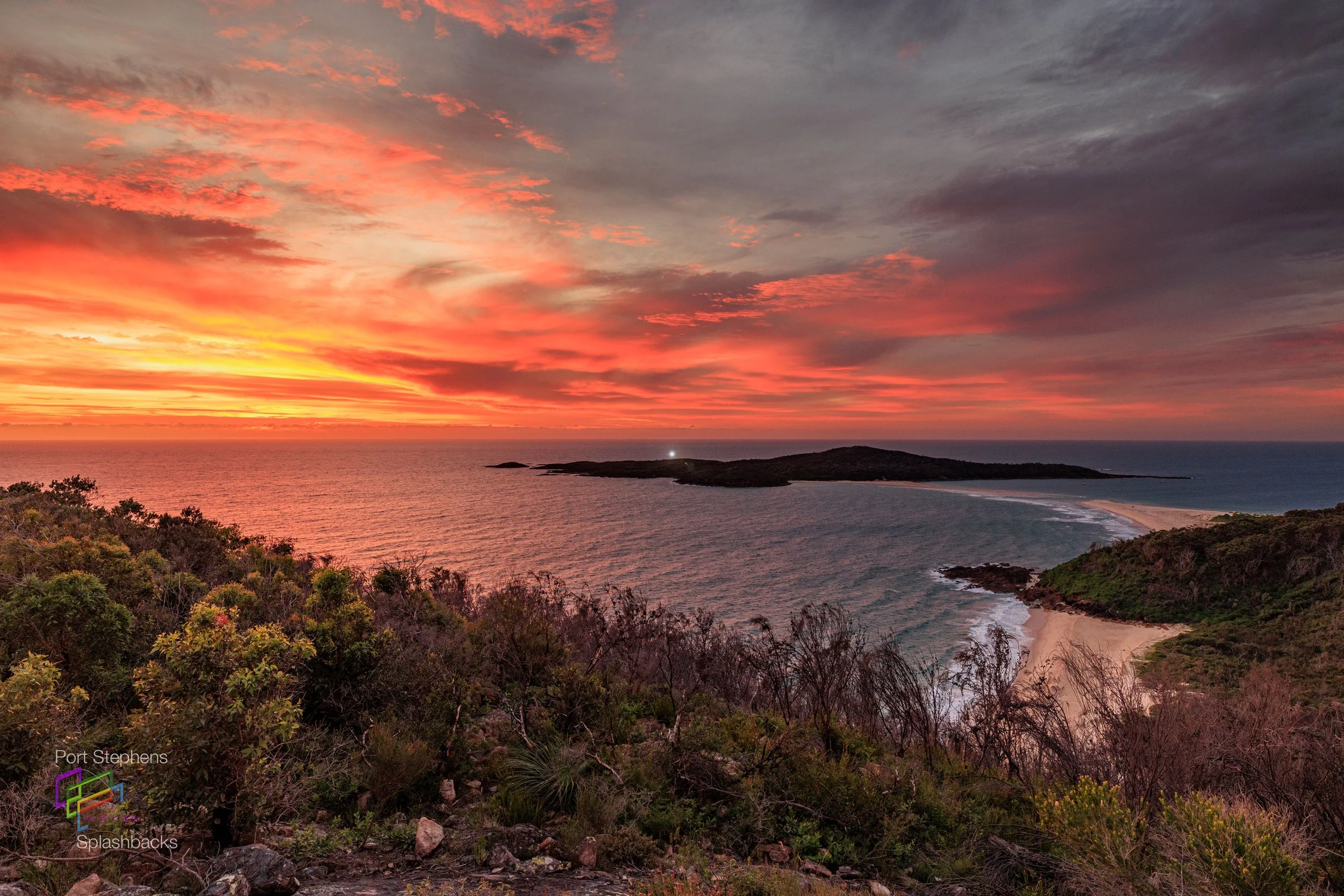
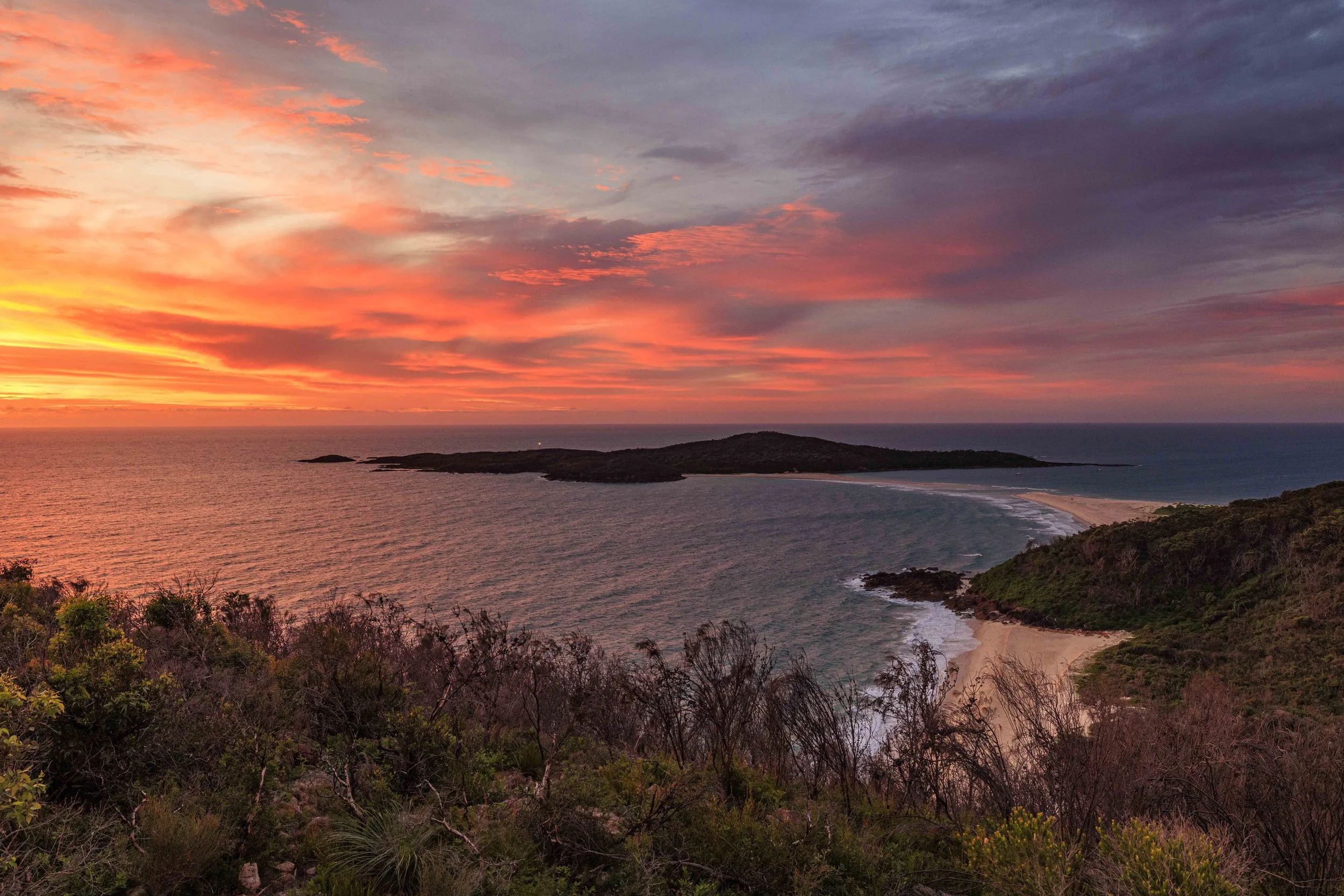
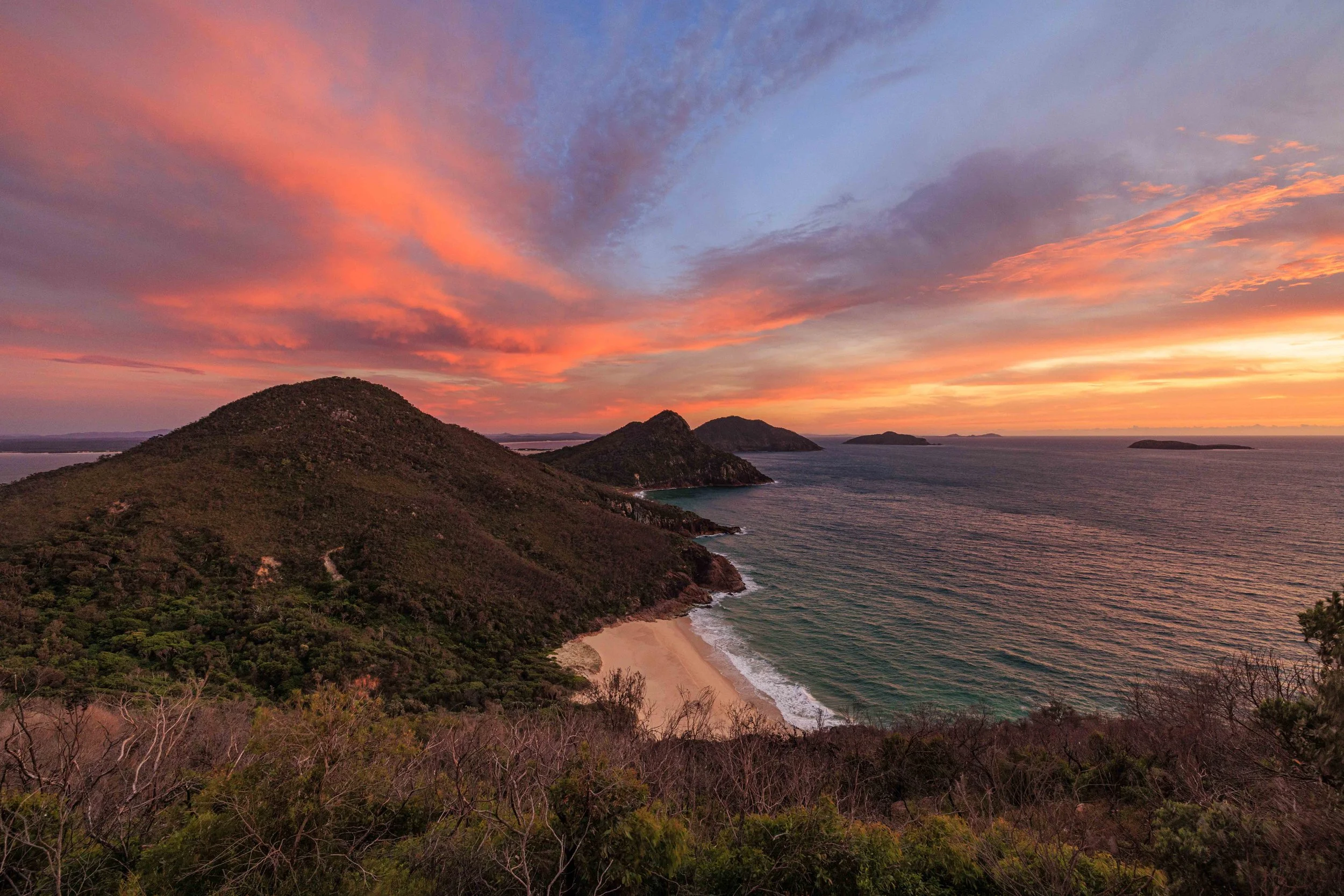
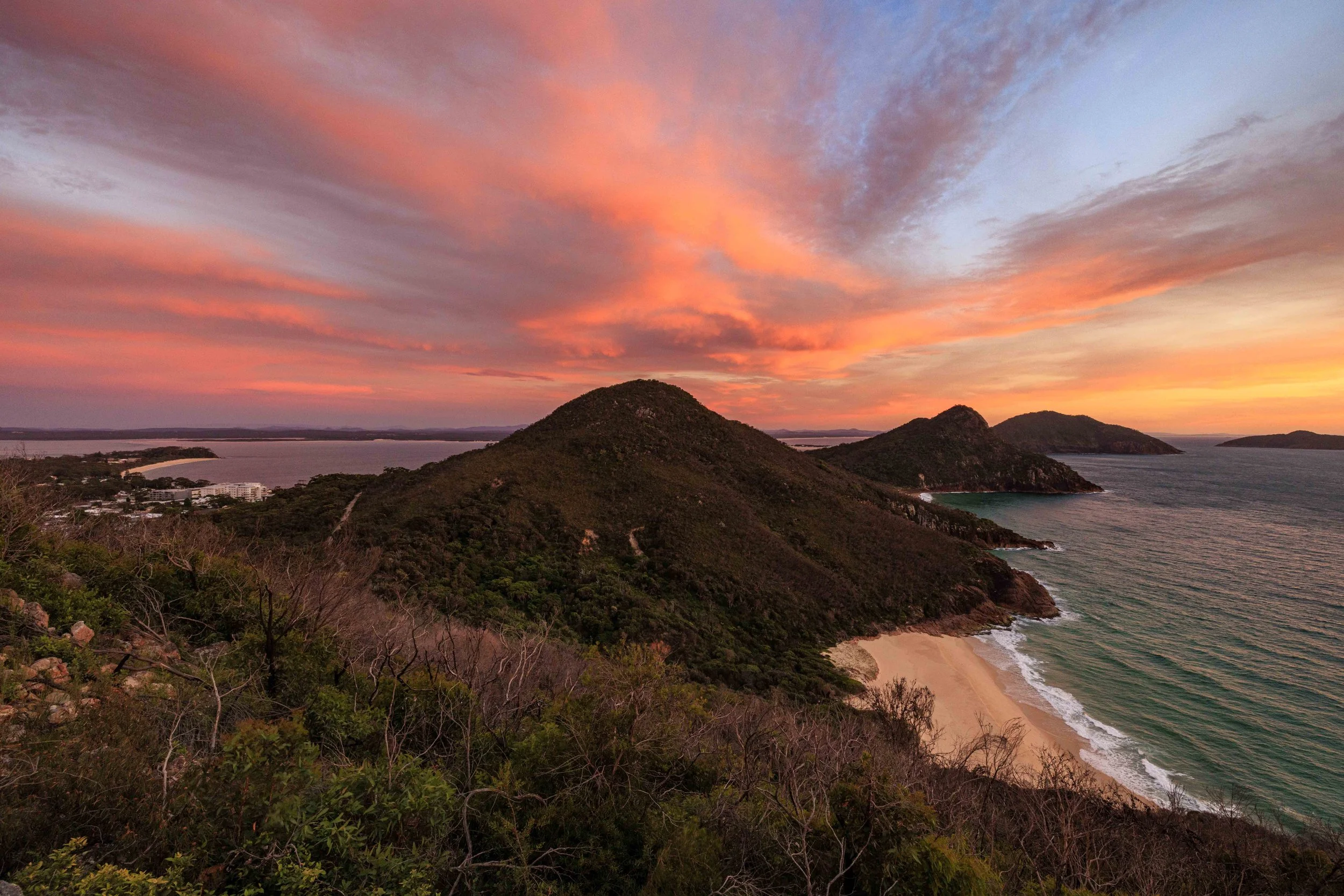
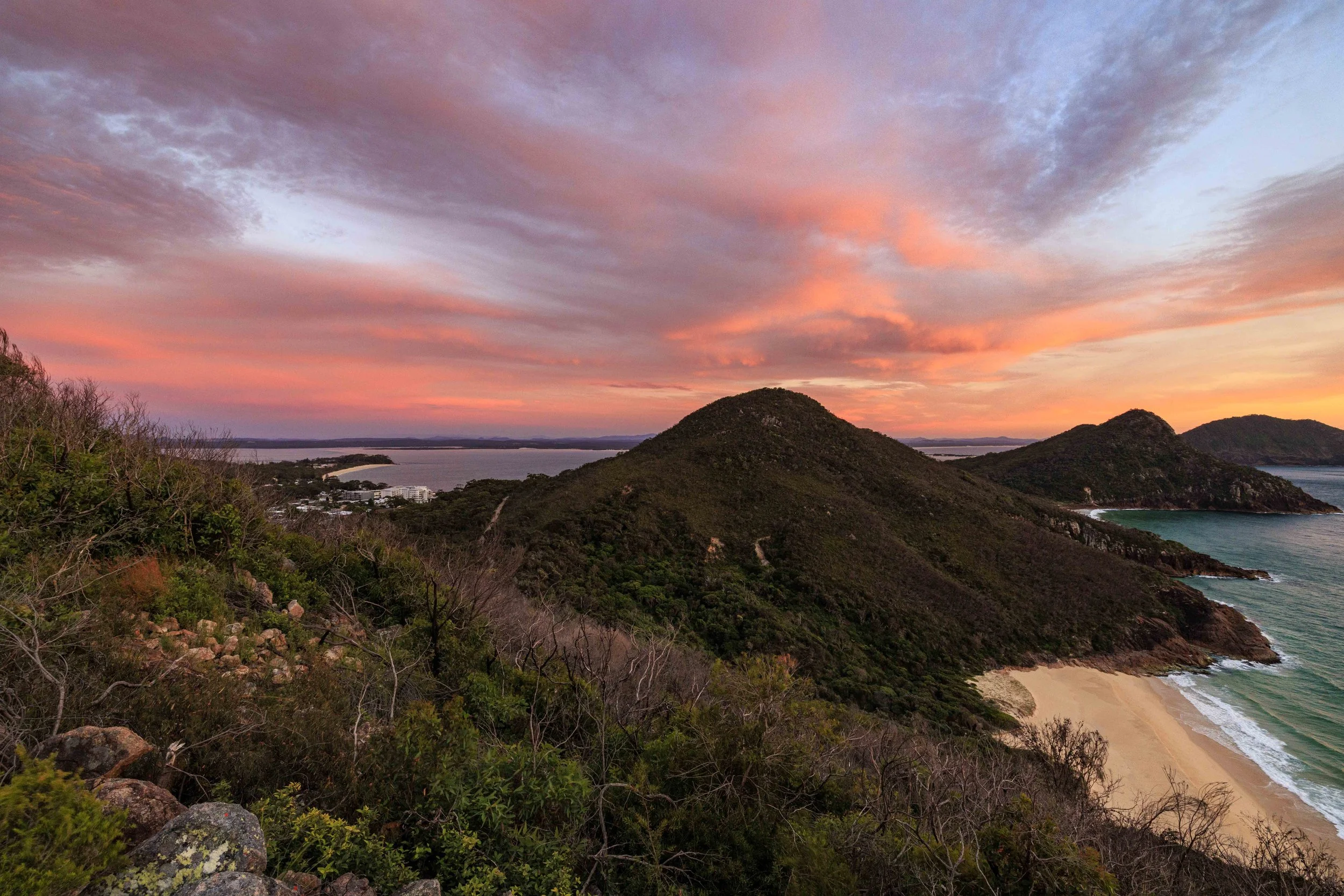
I climbed through webs and wind to find the sky on fire — a fleeting promise kept by morning light.
After clocking off from the factory at midnight, the world felt heavy with silence. Most would turn homeward, collapse into sleep, and let the night swallow the hours before dawn. But not me. The forecast whispered of a “colourbomb” sunrise, and the thought of that fleeting fire above the sea was enough to keep me awake.
By 3:30am my alarm was calling me back to life. Soon after, I was on the climb, the beam of my headlamp cutting through a shroud of darkness. Quarry Hill rose ahead, its outline sharp against the fading stars. Each step forward tangled me deeper into the night — through a maze of silver webs strung across the path, through the hush of the bush still holding its breath.
The rocks shifted beneath my boots, the climb uneven and uncertain. But fatigue fell away with each gust of cool air, each glimpse of the horizon widening above me. When I reached the top, the wind was waiting — strong, restless, tugging at my jacket, howling across the ridge like it wanted to carry me away.
Below, the sea murmured- waves crashing against the rocks of Wreck beach. And beyond it, the Point Stephens Lighthouse pulsed its rhythm into the dark — a slow, steady heartbeat against the sleeping world.
Then, at last, the first breath of dawn. A faint shimmer brushed the horizon, and the clouds — a dance of alto-cumulus and cirrus — caught fire. Gold spilled into pink, pink into orange, orange into the deep blue of retreating night. The familiar sound of the whip birds made the moment just perfect.

Box Beach just below with the Spit and Fingal Island in the distance. I timed the shot to pick up the lighthouse flashing.
For a brief moment, everything stilled. The wind eased, the ocean hushed, even the birds seemed to pause — as if the whole world was holding its breath to watch the light arrive.
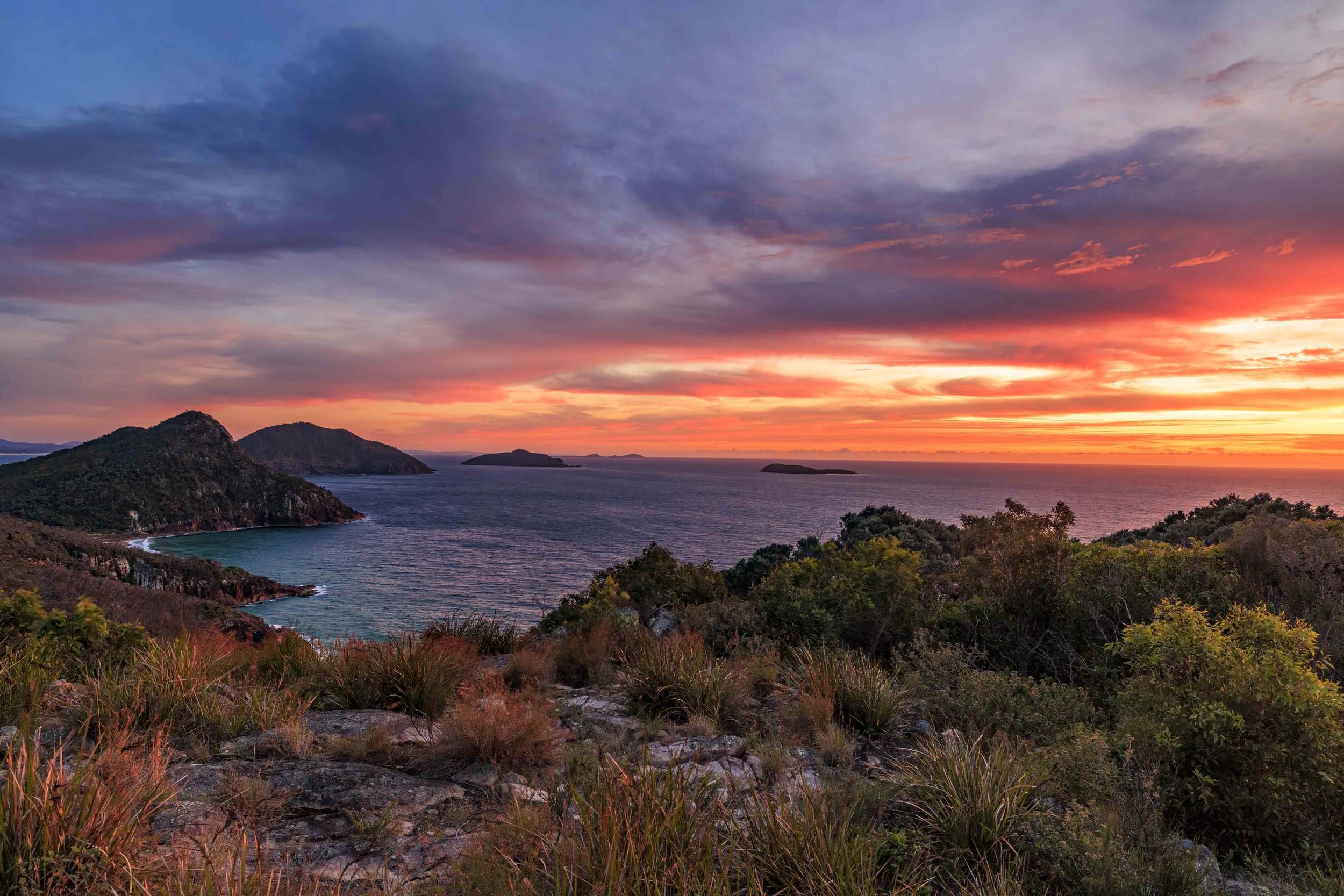
My vantage point on the top of Quarry Hill. It was quite windy on the north face, but if you moved towards the southern side, it was a bit more protected from the north-westerly wind.
And standing there, after climbing through the quiet hours, I understood: the climb, the darkness, the waiting — they were all part of it. You don’t find colour like that without first walking through the black.
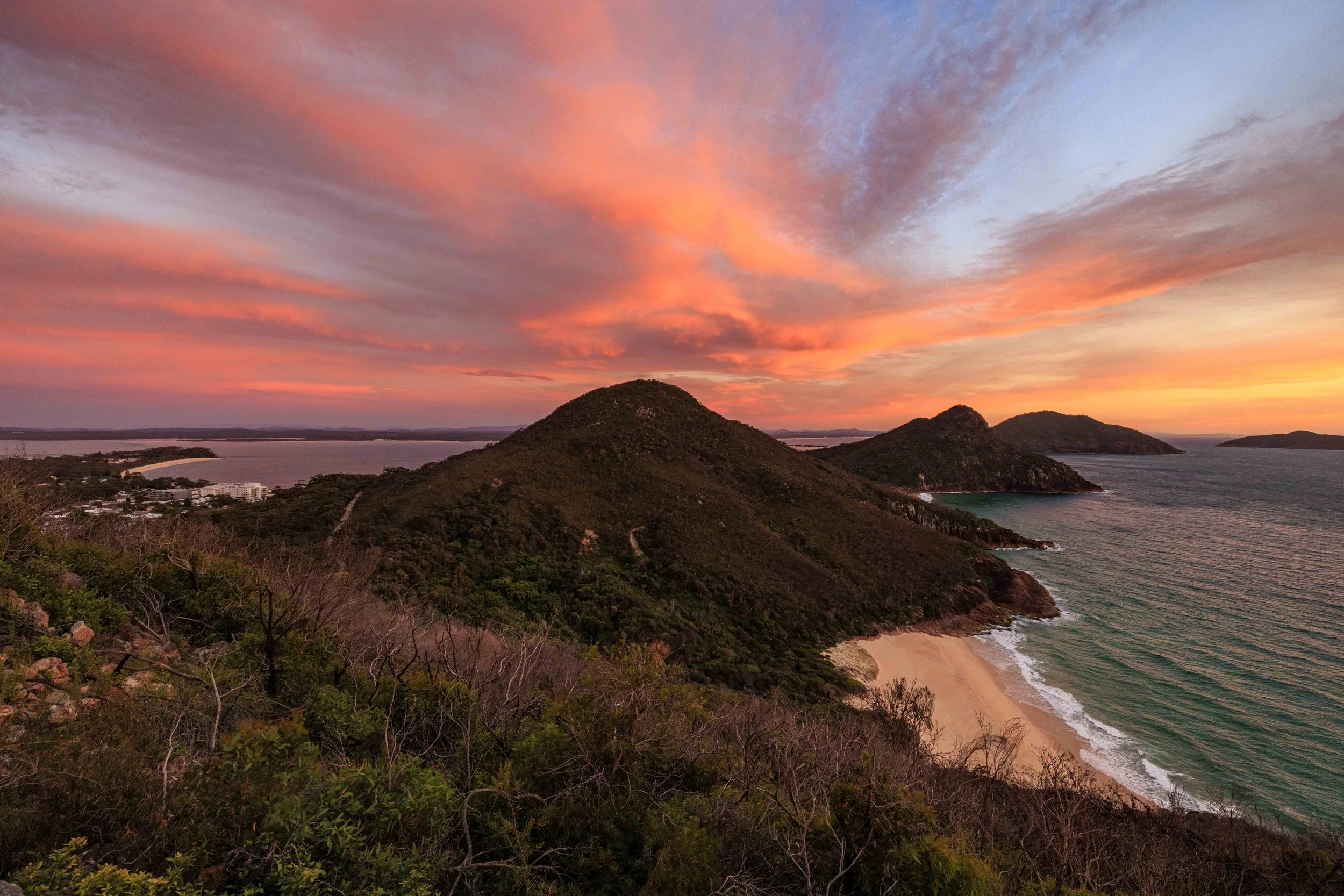
Looking down towards Wreck Beach. To the left is Shoal Bay, stretching out to Nelson Head. The mountains to the North are Stephens Peak, Tomaree and Yacaaba.
Author’s Note
Sometimes the best light is the one you have to fight to see. The kind that asks for sleepless hours, for cold winds and uncertain steps. But when it comes — spilling over the hills, setting the sea alight — you remember why you came. It’s not just about the sunrise; it’s about the climb through darkness that makes it burn so bright.


Welcome to storm season 2025
Chasing the First Storm of the Season
The first storm of the season rolled into the Bay on a Friday night — a full symphony of light and thunder. From the moment I saw it building on the horizon, I knew I couldn’t just watch it from home. I grabbed the camera and made for the top of Gan Gan Hill, my favourite vantage point for when the sky decides to put on a show.
The storm was slow-moving at first, crawling in from the west like it was testing its strength. The sky pulsed with flashes of distant lightning, each one a promise of what was to come. I could feel the tension building — that electric mix of humidity and anticipation that always comes before the first real storm of summer.
As it gathered pace, I moved with it, trying to stay one step ahead. My goal was clear: be in the right spot to capture the moment it hit Shoal Bay. By the time it reached the cooler waters of the coast, the storm had found its full voice. Bolts of lightning began crashing down in furious succession, the sky alive with energy. And then came the rain — heavy, relentless, blurring the horizon in sheets of silver.
It was both frightening and exhilarating. My heart raced as bolt after bolt struck the ground around me, the thunder cracking like gunfire and echoing across the water. Every flash illuminated the Bay in ghostly whites and purples, revealing a world caught between chaos and beauty.
There’s something raw about moments like this — when nature reminds you just how small you are, and yet, how alive. As the storm passed and the last rumbles faded into the distance, I stood there drenched and grinning, memory card full and spirit completely recharged.
The first storm of the season never disappoints


Mobile showroom this Sunday
Our next mobile showroom will be at Newcastle Farmers markets this Sunday 19 October from 7am - 1PM. Here’s your chance to see our product and find out more about how we make them.

When Removing an Old Splashback Is Necessary: Lessons from a Tough Installation
Why Sometimes You Can't Just Install Over Existing Tiles—and the Challenge of Tempered Glass.
In most kitchen renovations, installing a new splashback is a straightforward process. Typically, you don’t need to remove the old splashback or tiles; the new one can be fitted right over the existing surface, saving time, money, and a fair bit of mess. That’s especially true if you’re working with glass splashbacks, which can often be glued directly onto the previous layer with minimal fuss.
However, every so often, a unique situation crops up that forces you to take a different approach. In a recent installation, we encountered exactly that—a scenario where removing the old splashback was unavoidable. The reason? The client wanted to upgrade to a 6mm thick glass splashback behind the cooktop, but there simply wasn’t enough space to add that thickness on top of the existing tiles. Sometimes the dimensions of the kitchen or placement of appliances leave you no choice but to strip everything back to the wall.
Complexities of Splashback Removal
Removing an old splashback isn’t always as simple as it sounds, especially when you’re dealing with tricky materials and stubborn adhesives. In this case, the walls behind the splashback were solid concrete—already a tough canvas to work with. On top of that, the previous installer had used an excessive amount of silicone to fix the glass in place. Silicone is fantastic for waterproofing and flexibility, but it can be a nightmare when you need to pry something loose. There was no gentle way to get the splashback off; smashing was the only option.
How Tough Is Tempered Glass?
This installation provided a great example of just how strong tempered glass can be. Tempered glass is designed to withstand knocks, heat, and everyday abuse in the kitchen, so it’s not surprising that after several hours of hammering, the glass refused to break. It was both frustrating and impressive—just goes to show the quality you’re getting with a glass splashback!
Eventually, I found a weak spot and, with the help of a crowbar and a heavy hit, managed to break through. If you ever need to do something similar, make sure you’re prepared for a workout and have the right tools on hand. It’s certainly not a job for the faint-hearted.
Safety First
Whenever you’re dealing with glass, especially when breaking it, safety is paramount. In this case, I used a vinyl sticker to cover the glass before attempting to smash it. This simple precaution helped prevent shards from flying everywhere, making the clean-up much easier and reducing the risk of injury. Of course, safety goggles were a must as well—protecting your eyes from stray fragments is non-negotiable.
Final Thoughts
While most splashback upgrades can be done without removing the old one, there are exceptions. If space is tight or there are structural concerns, removal might be the only way forward. When faced with tough materials like tempered glass and stubborn silicone, patience, the right equipment, and a focus on safety will get you through. And if you ever doubt the durability of your glass splashback, just remember—it might take hours of hammering before it finally gives in!
An Unforgettable Encounter with Black Cockatoos in Bargo
If you're looking for a truly unique and heartwarming wildlife experience just outside of Sydney, let me introduce you to something special: the Black Cockatoo Experience at Feathered Friends in Bargo, NSW. This remarkable sanctuary offers an intimate and educational encounter with some of Australia's most charismatic — and endangered — birds.
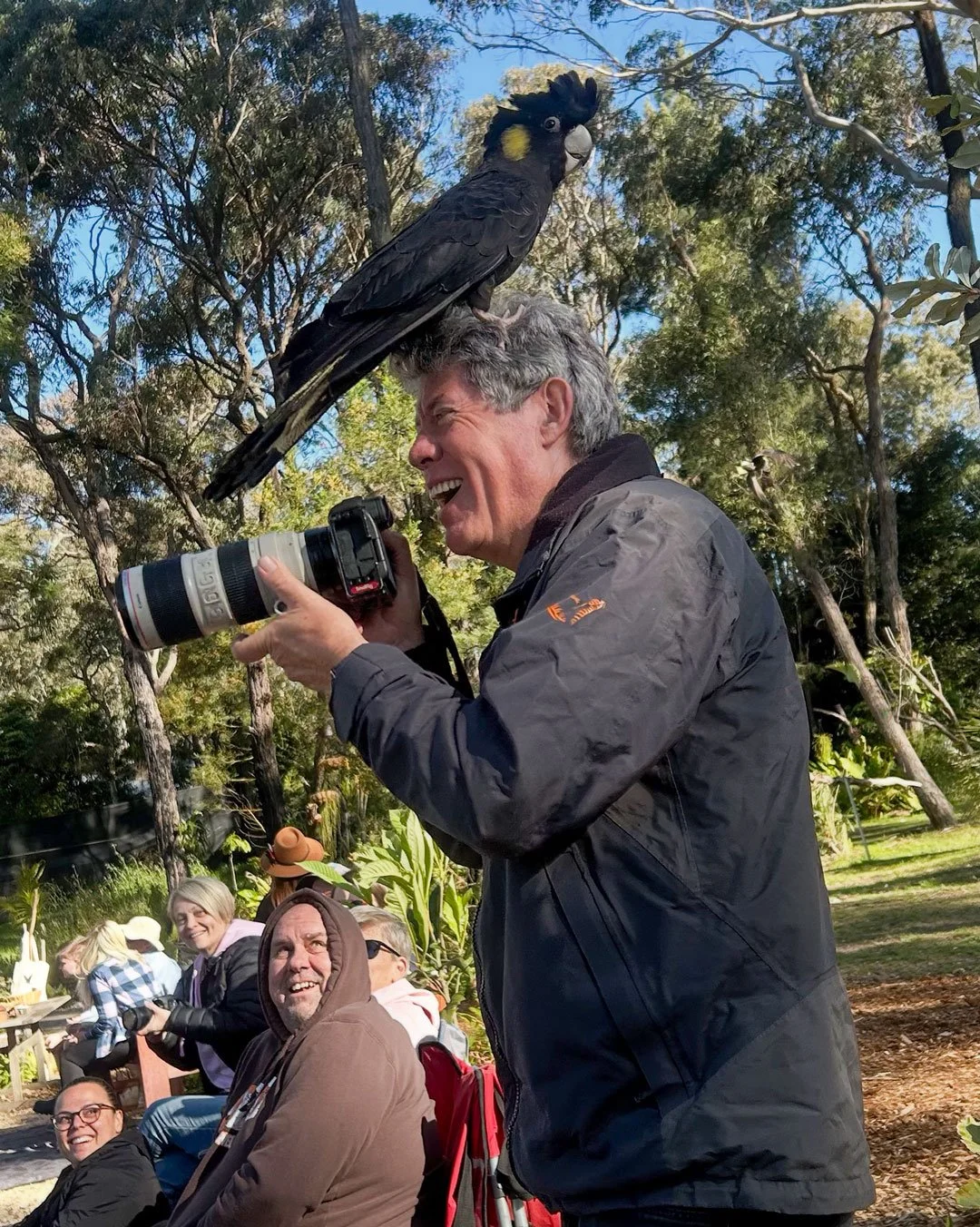
Photographing black cockatoos can be a challenge… This takes it to a new level
A Sanctuary with a Purpose
Tucked away in the peaceful surrounds of Bargo, Feathered Friends is far more than a bird sanctuary. It’s a haven dedicated to the preservation and care of native bird species, with a passionate focus on black cockatoos. The team here — many of whom are volunteers — work tirelessly to protect, rehabilitate, and advocate for these iconic Australian birds.
What makes this place truly special is their hands-on, conservation-driven approach. The Black Cockatoo Experience isn’t a zoo-like visit where you peer at birds from a distance. It’s immersive, interactive, and deeply personal.

red-tailed black cockatoo
Meet the Stars: Black Cockatoos
The 90-minute experience takes you up close and personal with several species of black cockatoos, each more fascinating than the last. You'll meet:
· Yellow-tailed Black Cockatoos – Known for their haunting calls and gentle curiosity.
· Glossy Red-tailed Black Cockatoos – Vibrant and cheeky, they love to engage with visitors.
· White-tailed Black Cockatoos – Rare and majestic, with a unique personality and presence.
These birds are incredibly intelligent and social, and the experience is designed to let their natural behaviour shine through. You’ll learn about their individual stories, their distinct personalities, and the threats they face in the wild — primarily due to habitat loss and urban sprawl.
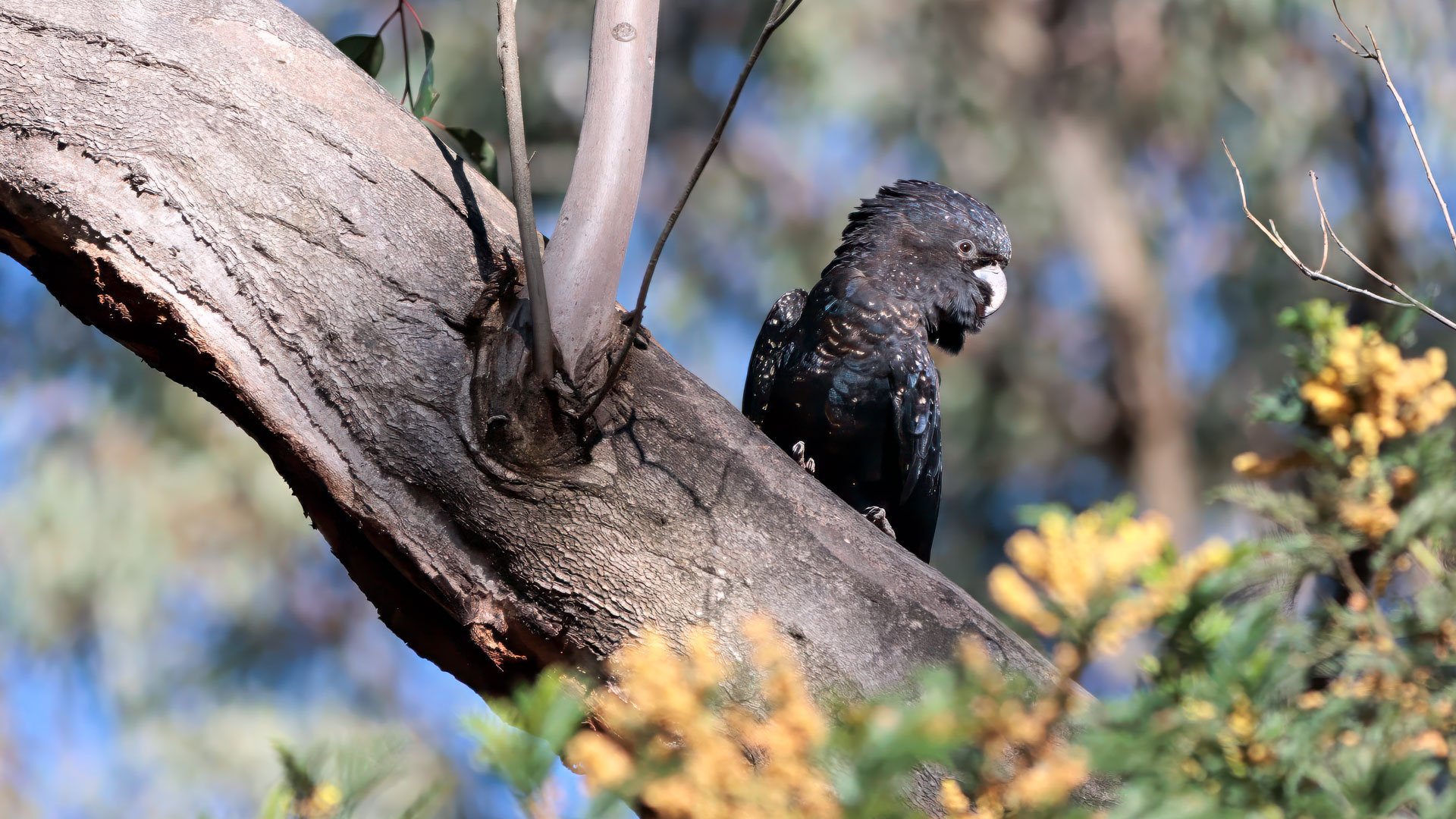
Black cockatoo
Why It’s Worth the Trip
Feathered Friends isn’t just offering an unforgettable wildlife encounter — they’re fostering a connection between people and birds that could very well be the key to the species’ survival. Every visit directly supports their conservation work, including habitat restoration, education programs, and breeding initiatives.
And trust me — the connection you’ll feel during this experience is profound. From the gentle weight of a cockatoo on your arm to the mischievous way they interact with guests, you’ll leave with more than just photos; you’ll take away a sense of awe and responsibility.

white-tailed black cockatoo
Planning Your Visit
Due to the intimate and interactive nature of the experience, spots are limited — and book out months in advance. So if this is on your bucket list (and it should be), make sure to plan ahead. The experience runs for about 90 minutes, and all ages are welcome, though younger children may need supervision.
Bargo is around a 90-minute drive from Sydney (3.5 hours for us from Port Stephens), making it perfect for a weekend adventure or a day trip with purpose. We travelled down and stayed the night at the Caballo retreat, which is a cosy cottage on a nearby horse farm and a great place to stay.

Black cockatoo in the mating tree
More than just cockatoos - they have a few surprises in store…
The Black Cockatoo Experience with Feathered Friends isn’t just another wildlife tour — it’s an encounter that stays with you. It’s a moment of connection with creatures most people only glimpse in the treetops. And it's a powerful reminder of what we stand to lose if we don’t act to protect them.
So, if you love birds, conservation, or just meaningful travel experiences, put Bargo and Feathered Friends on your radar. You won’t regret it.
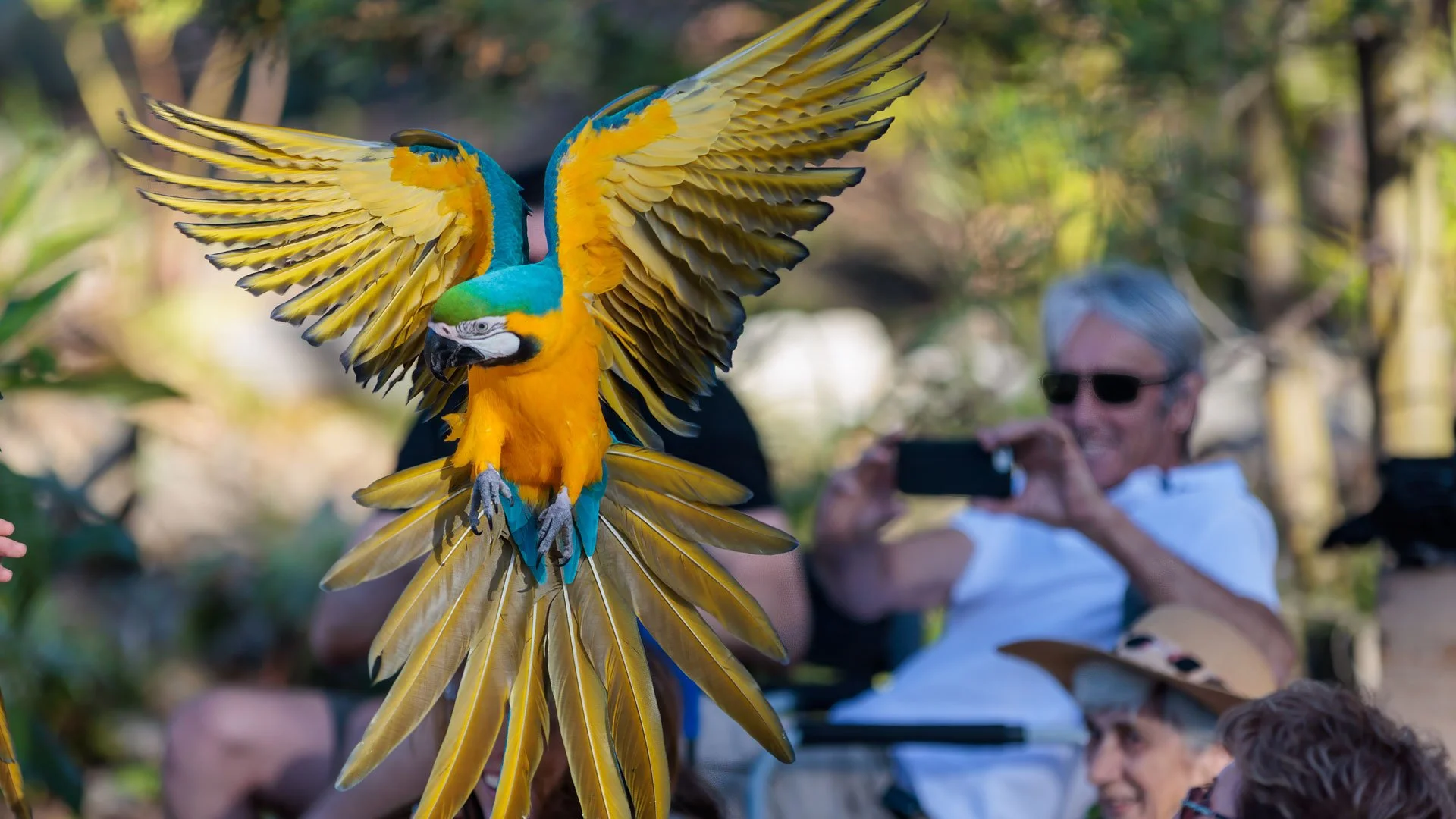
A macaw joins in on the show to the delight of the crowd
Chasing Shadows: Capturing the Lunar Eclipse Over Shoal BayMy Pre-Dawn Adventure on Stephens Peak
There’s something about a lunar eclipse that sparks a sense of adventure and awe, especially when the forecast promises clear skies over a spot as beautiful as Shoal Bay. With enthusiasm (and a hint of sleepiness), I decided that this eclipse deserved more than a casual glance from my backyard. I wanted a striking foreground to pair with the celestial show—so, Stephens Peak it was, and 4am became my time to shine.
Planning the Perfect Night
The ecliptic event was due to begin at 1:30am, but with the eclipse reaching its peak at around 4am, I wasn’t going to risk missing a moment. My alarm buzzed at midnight and, after a quick coffee, I packed my camera bag. I brought along a 16-35mm lens for sweeping wide shots, my trusty 24mm tilt-shift lens for stitched panoramas, and a hefty 100-500mm lens for detailed close-ups of the moon itself. That’s a fair bit of glass to lug uphill at that hour, but I figured it was better to have too much kit than not enough.
The Trek Up Stephens Peak
Shoal Bay was still and quiet as I made my way up the trail to a tiny ledge on Stephens Peak. The full moon lit up the track, casting long shadows and giving the whole scene a silver-blue glow. The ledge itself wasn’t much wider than my boots, and with a long drop on one side, I was glad for the bright moonlight to steady my nerves—and my footing.
Adjusting to the Unexpected
As the lunar eclipse began, I quickly realised that at a 60º elevation, the moon would be perched quite high in the sky. Shooting in portrait orientation became a necessity to capture enough of the sky and foreground. This meant that my 24mm tilt-shift lens, while great for panoramas, just couldn’t offer the height I needed. In hindsight, I could have left that lens at home and saved some weight for the climb. The 16mm portrait setup became my go-to for the wide compositions, and I made peace with the extra exercise—after all, who’s going to complain about a bit of a workout with views like this?
Dealing with the Dark
During totality, the moon’s light faded dramatically, and the world grew much darker than I anticipated. Before the eclipse, the full moon was a brilliant natural torch, illuminating the top of Stephens Peak and making it easy to move around. Once the show started, though, my trusty rechargeable lights became essential—until, of course, their batteries ran flat after a few hours. I ended up relying on my phone’s torch to avoid wandering too close to the edge while racing to change lenses and capture as many perspectives as possible. Mental note for next time: bring extra lighting for any prolonged astrophotography adventure. The final moments of the blood moon were perfect as the moon sank down towards Shoal Bay. Just as the red started to change back to the brilliant white of a full moon, it sank into a cloud bank so the final moments of the eclipse were lost- but I got the exciting bit of the red moon which was the memorable part.
Final Thoughts
Despite a few gear challenges and a brief encounter with total darkness, watching the lunar eclipse unfold over Shoal Bay from the heights of Stephens Peak was an unforgettable experience. The blend of natural drama and careful planning (with a side of improvisation) made for one of those rare nights that stick with you long after the moon has returned to its usual brilliance. Next time, I’ll be even better prepared—but for now, I’m grateful for the memories and the images captured beneath that ever-changing sky.

The lunar eclipse as it unfolded over Shoal Bay. the top moon image was at 3:30am, and the last image was at 5:10am, as the moon disappeared into a thick bank of cloud. The positions of the various stages of the moon are as they were positioned at their correct positions in the sky for that stage of the eclipse.

500mm shot of the moon in eclipse over Shoal Bay
Mobile showroom 6 September 2025
Join us for our Spring mobile showcase at the Newcastle Farmers Markets. 7am - 1PM at Newcastle Showgrounds Griffiths Road entrance.

The Spring mobile showcase at Newcastle Farmers Markets.
For this market we will have limited stocks of StacknPots available.

Quarry Hill Sunrise: Off the Beaten
TrackChasing Light, Finding Adventure

panorama from a hidden ledge on Quarry Hill
Sometimes, the best adventures are the ones that don’t go to plan.
Recently, I set out for Quarry Hill with dreams of capturing a perfect sunrise. The shoot itself didn’t quite work out how I’d hoped, but instead of heading home, I decided to explore a little further—and what a decision that was.
After a couple of hours wandering through the wild, I stumbled upon an incredible ledge perched above a sheer drop, offering a view too beautiful to pass up. The catch? The spot was way off the beaten path, buried behind thick scrub and impossible to navigate in the dark.
Determined not to let this location slip away, I spent a few hours hauling rocks to set up small markers along the route and rehearsed the trek until I could find my way back—no matter the light. It wasn’t all smooth sailing; at one point, I took a tumble (nothing broken, just pride!).
With a good weather window lined up and my health insurance double-checked (just in case!), I set out at 4am, fuelled by the anticipation of photographing a sunrise from a spot that, as far as I know, has never been shot before.
I captured the journey on video and have included a clip of the final stage, navigating my way to the ledge as the first light crept in.


Mobile Showrooms for July
We have two mobile showrooms coming up this week at Medowie and Newcastle.

Markets are subject to weather - please check our socials on the day before

Markets on rain, hail or shine.
Mobile showroom 29 June at Bimbadgen Estate

See our display of printed scenic glass splashbacks in our marquee
This week’s mobile showroom
The mobile showroom will be at Speers Point Park Sunday 15 June from 10am to 2 pm.

mobile showroom details for 15 June 2025